Showing posts with label rural knowledge. Show all posts

Saturday, September 26, 2015

Foraging: It's More Than Just Berries


There have always been groups of people that have been considered a little on the weird side. Homesteaders and preppers are on this list right along with goths and punks. It is strange to think about it, but to the society at large,  preppers are as far out on the fringe as any group can be. There is a group however that even the majority of preppers and homesteaders consider to be "out there". What group could be so strange that the people who are considered strange avoid them? Foragers. I know this isn't true of all, but if you talk to 100 people about foraging, 75 to 80 will look at you like you have grown another head. The ones that do not automatically think you are nuts usually think some type of berries like blackberries, blueberries, and the like. Once you tell them there is a lot more to it a large portion of these folks get the look. Some even find the topic interesting, but say they could never do that. I have friends that say I am the only one they know that can graze like a cow. They are exaggerating but I love foraging.

Like so many things, my love of foraging started with my grandfather. We would be out hunting or fishing or whatever and he would see a plant and would pick it and say "Here boy eat this." I would and then he would tell me about the plant. I honestly thought everyone had this kind of childhood for a while, but then I realized that my grandfather had given me something very special. He had given me a thirst for knowledge and a love for nature and the outdoors.

What is Foraging?

Forage is one of those words that can either be a noun or a verb.  Foraging can be a noun or an adjective. When I looked for the dictionary definition I was surprised by something that was clearly stated on the first site I went to. It clearly said that some English speaking people would know this word.

According to Dictionary.com


noun
 
1. food for horses or cattle; fodder; provender.
2. the seeking or obtaining of such food.
3. the act of searching for provisions of any kind.
4. a raid.
 
verb (used without object), foraged, foraging.
 
5. to wander or go in search of provisions.
6. to search about; seek; rummage; hunt:

He went foraging in the attic for old mementos.
7. to make a raid.
 
verb (used with object), foraged, foraging.
 
8. to collect forage from; strip of supplies; plunder:

to forage the countryside.
9. to supply with forage.
10. to obtain by foraging.

This definition almost makes it look like foraging is just for animals and thieves.  Another site was even less flattering. It included most of the above and the following.

Forage - raid, pillage, plunder,  loot, or scavenge.

Wow, I would have never thought of the word forage being used in that way. If the right person saw that and was offended they would have to take that down. 

A Rural Economist Definition

Forage - The art or skill of being able to find food and/or medicine where there appears to be none, using of the natural resources for provision.   

Now I will admit that I love foraging. I mean that. There are few things in the world as satisfying as seeing something growing in the wild and being able to use a resource that others think is useless. 

History of Foraging


There is really no way to adequately cover the history of foraging in anything less than a massive textbook.

Foraging has been an active part of the human condition for as long as there have been humans and it doesn't matter what your thoughts are on creation. If you are an evolutionist, foraging should be obvious. If you believe in a Divine Creation as written of in the Bible, then the Garden of Eden would have been foraging at its best. 

There are still tribes of people in this world that primarily support themselves through the acts of hunting/gathering. Even after what we would now consider agriculture started, people didn't abandon foraging.  It did shift a little, but not much. When a person was walking through a field or the woods and they found something that was edible, especially if it tasted good, they harvested it, no question. Many plants were harvested and dried because of their ability to make other things taste better. We now call those seasonings or herbs. 

There have always been at least one person in a group of any size that has specialized in medicinal herbs. In Native American cultures these were called Medicine Men or even Shaman. In the European culture these people were called either physicians or apothecaries. 

Foraging was not abandoned by the majority of people until the last couple of generations. 


How to Learn Foraging


Foraging is not one of those things that you want to learn by trial and error. There are some plants that taste bad that are edible, willow comes to mind because it is very bitter, and there are plants that I have been told actually taste pretty good that will make you very sick or even kill you. I have often wondered how someone figured out how to prepare American Poke weed. In my imagination I see a conversation going something like this.

Friend:"Joe are you okay?"

Joe:"Yeah, I'm fine, just got really sick after I ate that plant."

Friend:"Well don't eat it anymore."

Joe:"I wonder if it would be okay after I cook it?"

Friend:"Joe, are you serious?"

Joe:"Yup."

It had to be something along those lines because pokeweed leaves can make you very sick, but they were a Depression mainstay for many in the Southeastern United States. Not only do you have to cook it by par boiling, but it is suggested that you do so twice and dispose of the water each time. So how would someone who is interested in learning do so?

 Get a Good Book


A good field guide is worth its weight in gold when it comes to foraging. You can start with a general foraging book. These will give you a lot of plants, some of which will be in your area and some will not. Things to look for are good quality pictures and a listing of toxic look a likes. If a book lacks either, find another book.


Find a Mentor


Even though about 75% of the people you run into will think foraging is weird that means about 25% don't and at least of few of those will have knowledge you don't. Thus far I have managed to find someone in every community that has some knowledge about foraging. I know this sounds too easy and just as it is written it kinda is. When you find someone who knows a thing or two about foraging ask them who they learned from. Sometimes they will be able to refer you to a mentor, sometimes they will be like I am and will have learned some from an ancestor and have self taught the rest, or you may find they taught themselves with a book. Either way it is always easier to learn when you have someone with you who is more experienced. But there are some guidelines that you should consider when choosing a mentor.
  1. They should encourage you to bring your field guide with you.
  2. They should be willing to answer questions.
  3. They should eat everything they show you first.
  4. They should be confident outside.


Join a Foraging Group


Foraging is actually as one article put it "on the cutting edge of modern culinary culture" needless to say foraging is suddenly back in style. Foraging groups are popping up around the world. Larger cities will be more likely to have a foraging group. I have even heard that there is an active foraging group in New York city. I hope they don't get caught eating plants in Central Park.


There is a lot to be said for being a part of a learning group. Someone may think of a question that you didn't, but as soon as you hear it, you really want to know the answer. There is safety in groups and more eyes means more success.

Watch Videos on Wild Edible and Medicinal plants

Not to toot my own horn, but as of now I have 18 videos each of which cover an edible or medicinal plant and have several more in the works, and I am not the only one. You can check out and subscribe to my Youtube channel HERE.  There are dozens of people out there that will help you learn. I personally like learning from videos, they give me a better understanding of the surrounding areas, what to look for, and even the textures of a plant than any book really can.

The Best Way is a Mixture


For anyone and everyone starting out I always suggest getting a book that is based on your area. When you take this in conjunction with videos, and either a foraging group or a mentor, it will make things so much easier.

One Word of Warning

I have had people ask where they could take a couple day course to become proficient at foraging and the answer is nowhere. If you find an instructor that tells you, you can effectively learn to forage in just a couple of days they are just out for your money and if you take their advice and actively start foraging you will get very sick or worse.

So get a friend and buy a book, watch some videos, find a mentor, or a combination and get out there and learn about all of the wonderful things that God has provided for us in nature.

Bringing Rural Back

Subscribe to our mailing list

* indicates required


You can like The Rural Economist on Facebook follow on The Rural Economist on Gplus. We now have a YouTube channel and we cover all sorts of things. Hop on over and check them out, oh and don't forget to subscribe. I have just joined Instagram if you would like you can follow us HERE. We will be sharing several things over the next year, I hope to see you there. 

Check out The Rural Economist on Pinterest

Affiliate Link Disclosure: This post may contain affiliate links. I may receive compensation for links, endorsements, testimonials, or recommendations for any products mentioned on this blog. If you see something you are interested in, check them out. Thanks for your consideration.

Wednesday, June 25, 2014

Wild Edibles #5 Queen Anne's Lace or Wild Carrot


Disclaimer: Some wild plants are not only edible but delicious. Other wild plants will kill you if you eat them. Be absolutely certain what a plant is before you eat it. Plant varieties differ from region to region. When in doubt, consult a local expert.

There are at least two species of Queen Anne's Lace in the United States. One is native and one was imported from Europe. Both varieties are also known as Wild Carrot. Wild carrot is a biannual plant. This means that it produces flowers and seed in the second year. The first year wild carrot is characterized by small growth. In Queen Anne's Lace early stages of growth it is very difficult to tell apart from a garden carrot. The fern like leaves when crushed smell just like carrots. In the second year Wild Carrot can grow to about 4 foot in height and has a very characteristic umbrella shaped flower head.

Caution: There is a poisonous plant that looks very similar to Queen Anne's Lace. It is called Poison Hemlock. A small amount can kill a full grown man. Here are this things to consider when trying to tell them apart. One. Wild Carrot has fine little hairs all up and down the stem. If the plant you are looking at does not have these hairs leave it alone. Two. Every part of the Wild Carrot smells like a carrot. You can roll the leaves in your hand, if it smells really bad it is poison DO NOT LICK YOUR HAND!!!!!!! Wash your hands well as soon as you can.

As Food

Nearly every part of this plant is edible. The only part of this plant that is not edible is the stem. The root of the wild carrot is most tender in the first year. During the second year it develops a woody core, which must be cut out for best eating. The second year even after the woody parts are cut out the root is still very tough, cooking can make the root more palatable. The root can be used is stews, soups, or even just boiled. If you have really tough teeth you can eat the root raw.

The leaves can also be eaten raw or cooked, and can be used in all the ways garden carrots greens can. Oh in case you didn't know you can eat the greens of garden carrots as well. The tops of the wild carrot can be eaten in a couple of ways. The tops when fresh can be deep fried or sauteed. As the flower matures it closes up and resembles a bird's nest. The bird's nest is this plants way of protecting the seeds. The dried seeds can be used to add a carrot like flavor to many dishes.

As Medicine

Again every part of this plant can be used for medicinal purposes. The leaves and root of Queen Anne's Lace can be dried and used as a tea that has been used to treat kidney problems including kidney stones, bladder problems, water retention, and to reduce uric acid a primary cause of gout.

Oil from the seeds has been used to treat severe diarrhea, indigestion, and intestinal gas. Seed oil has also been historically used by women to help start menstruation.  

There have been records of this plant being used to treat heart disease, cancer, internal parasites, to calm the nerves, and heck a tea made from the dried leaves has even been used as an aphrodisiac. 

NOTICE According to the Carrot Museum the seeds of Queen Anne's Lace should not be used by pregnant women.

Below is the YouTube video on Queen Anne's Lace 


You can subscribe to The Rural Economist by email by simply filling out the form below. Your information will never be sold or given to anyone else. 


Subscribe to our mailing list

* indicates required


You can like The Rural Economist on Facebook follow on The Rural Economist on Gplus. Or you can even follow The Rural Economist on Pintrest. We now have a YouTube channel and are doing a series on wild edible and medicinal plants. Hope on over and check them out, oh and don't forget to subscribe.

Other Posts in this Series: #1 Wood Sorrel#2 Wild Strawberry and WoodberryWild Edibles #3 Dove's Foot Geranium, #4 Broadleaf Plantain

Wednesday, May 21, 2014

The Un-Country Country Wife


All of my life I have lived in the rural area of Blount County Alabama.I loved it so much that when I remarried I asked my husband if we could stay here instead.Of course he agreed and he has been diligent in making this county his home as well.

Now that being said,I may have lived in this area where there were cows raised right across the road from me and I knew a lot of the people who had grown their own veggies and placed them in competition at the county fair every year.My father grew up here as well.He was raised on a farm,hunted,and even grew his own vegetables.So that should mean I have experience right?

Guess Again.

I will not go into detail about my home life but I will say this.I had to learn to become self-sufficient at a young age.I learned to cook and clean,and even become a mom at the age of sixteen.However,I did not learn much about homesteading.Oh my dad did try when we were younger,but if I wasn't in the mood,I just told my mother and she would take care of that.How I regret this terribly.She was from the city and it was years after my father died that she realized that the country life was good.

Yet she almost had me believing this as well.There isn't much to do around the country when you’re a teen.And so I thought all the cows and chickens and farming was pretty lame.Why go through all this trouble?It’s  hard work and dirty and didn't seem enjoyable at all…

But then the strangest thing happened.I grew up.I started getting to know these people.I still was not completely convinced…


Then God gave me Gregg.

This man loves everything about dirt,and farm life and prepping (not the crazy kind that you see on television)
He was raised on a mountain and has done more than most people I know.And as a bonus,he loves to teach.So I have become his student (by choice!)


I have decided that I want to start sharing my adventures in homesteading since I may have come from the rural land but I truly am just now learning how to appreciate it. So everything is new and amazing and I hope that you will either learn something from it or have a new found love for it.

I am so excited having my wife write with me. For another post written by my wife you can read:

You can subscribe to The Rural Economist by email by simply filling out the form at the top right of the page. Your information will never be sold or given to anyone else. You can like The Rural Economist on Facebook follow on The Rural Economist on Gplus. Or you can even follow The Rural Economist on Pintrest. If you do the Facebook thing I have a poll going on right now and I would really love to have your input.

Hand in Hand Embracing the Homestead Life
If you can guess what classic American painting we are paying homage to please comment below.

Sunday, May 18, 2014

Wild Edibles #1 Wood Sorrel


Disclaimer: Some wild plants are not only edible but delicious. Other wild plants will kill you if you eat them. Be absolutely certain what a plant is before you eat it.

There is a short video at the bottom to help you identify wood sorrel.

Wood Sorrel also known as sourgrass has been eaten by Native Americans for hundreds if not thousands of years. Wood sorrel can be used for culinary as well as medicinal applications

Identification

Wood sorrel is characterized by heart shaped leaves, banana shaped seed pods. This plant has small yellow or white flowers. I have read they can also be pink. Wood sorrel grows to a maximum height of 15 inches. I have never seen it over 8 inches tall. 

One great thing about wood sorrel is there are no toxic look alikes. The plant most commonly mistakes for wood sorrel is clover and guess what not only is it nontoxic, it is edible also. Look for a post on it in the near future. Below are some photos to help you identify wood sorrel.

Heart shaped leaves, small yellow flower
Woody stem
Banana shaped seed pod


Culinary


Wood sorrel is high in vitamin C and has a slight to medium sore flavor. The flavor is very citrus like and close to that of a lemon. Has been used to help quench thirst and can be used to make tea.

This plant can be eaten fresh either alone or in a salad and goes great with fish especially if cooking on a campfire. There is very little information about using wood sorrel in cooking.

Medicinal

Wood sorrel has been used to treat mouth sores, upset stomach, fever, scurvy, to slow and/or stop bleeding and has even been used as an aphrodisiac. Some of these thoughts have been tested by modern medicine with mixed results. Either way this is a great plant to know.

Caution

This plant contains oxalic acid. Oxalic acid in large amounts is slightly toxic and can interfere with the bodies ability to absorb certain minerals, primarily calcium. Some people could be allergic to wood sorrel. Anyone who suffers from kidney problems, rheumatic disorders, or gout should not eat wood sorrel.

I hope you find this series interesting and informative. May you always be working toward your own

Rural Dreams and Homestead Wishes

You can subscribe to The Rural Economist by email by simply filling out the form at the top right of the page. Your information will never be sold or given to anyone else. You can like The Rural Economist on Facebook follow on The Rural Economist on Gplus. Or you can even follow The Rural Economist on Pintrest. You can also subscribe to The Rural Economist Youtube Channel.

Wednesday, April 30, 2014

Really!?! You Must be Kidding

Just having some fun with the photo!

I am increasingly surprised by how many things we as a society have forgotten. I am saddened by how many basic skills are being lost. The reason for this post is simple. One of the people I follow on twitter has a regular post on DIY home cooking. Normally these links are to things like gravy, stews, and things like that, but today the link was for homemade lemonade. I followed the link just for curiosities sake. Ingredients: lemons, sugar, water, and ice. My first reaction was really, have we fallen that far? But as usual when I go off the deep end my wife is there to draw my back. I have been making things homemade since I was a kid so I just have trouble understanding the need for such basic instructions. My wife had to explain that just the fact that this information is out there is proof that there is a growing interest from people in learning to do things for themselves.

This has been working in my heart for a while. Only a couple of weeks ago my wife and I were at the grocery store someone in line had a bag of ice. The slogan on the bag was "Better than home made". The cashier actually asked how you make homemade ice. This young person is in their 20's and is engaged to get married. There is no wonder that the ready made food business is booming. We have gotten to the point were millions of people both male and female do not know how to cook anything. These people do not even realize that they have lost a large part of their control over their own lives. If you control the food, you control the people.

Not too long ago a man at work paid $10.00 to have a  lamp assembled. I tried to tell him how easy it was to put together but he would not listen. He just said "I am not very handy". I talk to people weekly who have no idea how to do things that I think would be basic. Some people want to learn, but sadly most don't.

I just saw this, this morning. If the photo does not illustrate my point nothing will.

Arrows to show you where to open the cheese?
So how do we work to change the direction of our community, generation, and even country? First and most important is be sure we teach our children. Everyone should know what lard is, how it is made, and how it is used. I am going to have to do some cooking with lard in the near future. If we only do that ,we help assure that our decedents will not fall prey to rampant consumerism. We educate anyone who will listen about organic or natural gardening. We spread the word about GMO foods. Learn and spread the work about living frugally, recycling, and re purposing. Demonstrate how to make things from nothing. Encourage those that you have influence with to stretch themselves.

Remember to work toward making a reality your
Rural Dreams and Homestead Wishes


You can subscribe to The Rural Economist by email by simply filling out the form at the top right of the page. Your information will never be sold or given to anyone else. You can like The Rural Economist on Facebook follow on The Rural Economist on Gplus. Or you can even follow The Rural Economist on Pintrest. If you do the Facebook thing I have a poll going on right now and I would really love to have your input.

For similar posts please read:
DIY or DIFM
Helping a Friend and Teaching My Sons
Why Skill Development is So Important
DIY Preparing for a New Home

Tuesday, April 22, 2014

Family Memories (2) Taxidermy


Over the next several weeks we will be running two series simultaneously. Tuesdays will be Family Memories. There may be guest posts from various members of my family. This will be a way for us to share our experiences and lessons learned. Many of these may be short.

On Thursdays we will be running a series on Getting  Prepared for Beginners. These posts will have reasons to be prepared and helpful tips to get to a more self-reliant point.

I counted my wife's post God Gave Me a Carter as the first post in the Family Memories series. So here we go.

As I have stated many times before my grandfather was responsible for many of the skills I have developed. One day while I was visiting him he asked me if I was interested in taxidermy. I told him, "Sure". He gave me a complete set of books on taxidermy.

I threw myself into the books. Read everyone of them. Not only did he give me the books, he gave me a large box off wood wool, wire, several sets of eyes, and a catalog for ordering more supplies.

This was in the summertime as I recall so no hunting season was open. So a fishin' I did go. It only took me trying two fish to realize that either I was not artistic enough or I would have to apprentice with someone to do fish.

My next attempt was a bird. I was trying to come up with something to work with. At first I was hunting with my BB gun. I thought the small projectile would do less damage to the skin of the bird and make it easier to mount. I shot at crows, blackbirds, and starlings. I think all my BBs were doing was stinging the birds and making them fly off, so I finally resorted to my 410 shotgun with number 8 shot.

I finally took a red winged black bird. They are very pretty and I thought could make a nice mount. So there I was- bird on the table, book in hand, and tools and supplies laid out before me. 

You have to skin things differently when you are trying to save the hide. If I had been planning to eat that bird it might have taken me one minute to skin it. I was trying to make a lasting display of that bird. About 30 minutes later I had the bird skinned. I only tore the hide once and considering how thin their skin is I was pleased.

Trying to do taxidermy without a mold is an art. I worked with the wire and the wood wool for probably an hour. The body looked fine. I just couldn't get the legs to look right. I worked with it off and on for a couple of days before I found an abandoned nest. I placed the bird in the nest and I thought "not a professional job but good enough for a first". I kept the red winged black bird for a couple of years. It really wasn't a bad job.

Next I tried a snake skin, but used the wrong chemical and turned it green. I have made leather with the knowledge I gained from those books and have done a couple of nice squirrels using the molds. The molds make it a thousand times easier. I even made a couple of coyote skin rugs over the years.

Am a great at this skill? Oh heck no. Do I still cherish this skill? Absolutely. Just because you aren't great at something does not mean it has no value. Like I said I can make leather and furs. Will I ever do taxidermy again? Yup, I probably will. Will it be a business? Oh no. But every skill you learn makes you better.

Learn a new skill and it will help you to have
Rural Dreams and Homestead Wishes 

You can subscribe to The Rural Economist by email by simply filling out the form at the top right of the page. Your information will never be sold or given to anyone else. You can like The Rural Economist on Facebook. Or you can even follow The Rural Economist on Pintrest.

Saturday, November 9, 2013

Rural Wisdom and Know How #1

News From Around Carter Homestead:

Here in the South the weather is chaotic, one day the high will be the low 50's and two days later the mid 70's with night time lows ranging from upper 20's to low 60's. Our weather makes things interesting. For tonight at least I am sitting by the fire.

My wife is in full on "Let's get this Christmas shopping done" mode. Most of the shopping has been done on Amazon so far. She is incredible. No procrastination going on with her.

We have two birthdays this week both my wife's mother and mine. We also found out that my wife will be having to work Thanksgiving day and the weekend before, so we will be having to get creative in our celebrations this year.

I would like for this to turn into a real conversation. I would like to get to know all of you and give you a chance to get to know my family and myself. In that spirit I am going to post some questions each week and give my answers. I would like for you all to answer the questions in the comments.

(1) As we are coming up on Veterans Day, are there any veterans in your family?
(2) Do you do anything to celebrate Veterans Day?
(3) Have you started your Christmas Shopping?
(4) When do you start listening to Christmas music?

My answers (1) I am a veteran as are both of my grandfathers. Both of my grandfathers served during WWII. I have my paw paw's WWII flag that was on his casket and his father's WWI flag. (2) Sadly, I do not do anything special. I will have to work. (3) My wife is on this with a vengeance. (4) I listen to Christmas music anytime the mood strikes me February or even July is fine by me. My wife thinks it should wait till the day after Thanksgiving. Now it is your turn.
The Rural Economist


We have a giveaway going for copies of two eBooks. The Urban Chicken and The Gardening Notebook. You can enter for this giveaway either on the posts about these books or on The Rural Economist Facebook page. We are looking forward to hearing from you.

Saturday, November 2, 2013

The Urban Chicken a Review and a Giveaway


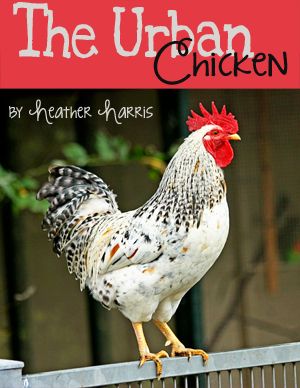
 photo TheUrbanChicken-CoverSmall.jpg


Hello everyone. I am really excited because on November 11th The Rural Economist will be celebrating its one year anniversary. We posted a few things before that time, but that is when I really got serious about sharing my projects, thoughts, successes, and failures. I am also excited because we will be offering our first giveaway. Heather at thehomesteadinghippy.com did an excellent job of putting together a very good book for someone who is thinking about getting chickens for the first time. 

Heather covers different laying breeds and the most popular meat chicken breed. She covers both chicken coops and chicken tractors with the pros and cons of each. She shows pictures of a chicken run that she made out of pvc (which makes me proud that I was not the only person who made their chicken housing out of that stuff).

Heather includes a recipe for homemade chicken feed and talks about the benefits of giving the chickens a chance to free range at least part of the day to help reduce feed costs. I really like being able to move my chickens around, though I will admit it has been a while since I have done so.

The chapter that impressed me the most was the chapter on How to Cut Up Your Chicken. Heather has included a step by step with very good quality photos. If you will follow Heather's instructions you will be cutting up your frying chickens like a pro in no time. (Do not get frustrated if the first couple of times does not turn out so well, that is normal.) 

Heather covers preserving your meat birds as well. She goes over the basics of freezing and canning the meat. She also includes several recipes.  Heather did an excellent job. This ebook is worth several times more than the $3.99 that she charges.

Now for the best part. Heather has given me permission to give away three copies of this eBook for The Rural Economist anniversary. There are three ways to have the opportunity to win this eBook. (1) Follow this blog by clicking the Join This Site button and leave a comment on this post. (2) Follow The Rural Economist on Facebook by clicking HERE. Then find the post about this eBook being given away and post my tagline. It is easy to figure out here is a hint it will be in italics. This eBook is a great recourse to help you....

Keep It Rural

Remember these ebooks will be given away by random draw on November 11th. I will announce the winners both on Facebook and here.

There is a contest running between homestead bloggers. If you like The Rural Economist you can vote for us here. Just find The Rural Economist and click "like" Thanks.


Summers Acres: The Good Neighbor Blog Hop

Saturday, October 19, 2013

Choosing The Chainsaw For You


Another name for Fall could be chainsaw season. It does not matter if you cut wood as a primary or backup heating source or prune trees or shrubs. Just being ready to deal with fallen branches or trees- a chainsaw makes a lot of jobs easier. 

This brings me to my topic of which chainsaw should you own. I have helped people choose a chainsaw many many times. When I have helped these people I see two distinct groups. Group one are the people who want the biggest, most powerful chainsaw they can afford. Group two are the people who want the smallest, cheapest chainsaw they can get. Which one is right? Would you be surprised if I said neither? I didn't think you would.

Before you decide on which chainsaw to buy figure out what kind of work you will really do with it. I use my chainsaw a couple of times a week. We use wood as a secondary and backup heating source. We have a solid chord and a half of wood waiting on cold weather. I am of the opinion that wood heat is going to grow in popularity in years to come and I am not alone. As other energy resources continue to get more expensive people are going to return to wood, in fact there are tax credits available for those who use "approved" wood stoves. Wood heating is a personal choice and I am not trying to talk you into wood heat, but if you are thinking about it that will be a factor into what type and size of chainsaw you need.

There are lots of choices. Several name brands and multiple sizes of each name brand. The first chainsaw I ever operated was a Homelite with a 6 inch bar. It was my first job to cut off small limbs after the tree had been fallen. As I got a little older I was allowed to run my dads McCulloch. It had a 20 inch bar and was very heavy. I used to own a Homelite with an 18 inch bar, but I lost it in the April 27th tornadoes (actually I was told that it was looted before I got to my business where I had it stored). I have also run a Sthil and a Husqvarna and currently own a Poulan, and they have all done their jobs well. So I believe as long as you take care of your chainsaw, name brand is a matter of preference.
This is the chainsaw I currently own.


All of the affordable chainsaws have 2 stroke engines. This means you must mix 2 cycle oil with the gas. Depending on brand and age of your saw, your saw may require 32:1, 40:1, or even 50:1 gas to oil ratio. Be sure and read your manual to get the mixture right. If you do not mix the oil with the gas your saw will not last long and you will burn up your saw. If at all possible find a place that sells 100% gasoline. Most older chainsaws are not designed to run on ethanol blends. Ethanol greatly reduces the lifetime of your saw. You will also need to make sure to have bar and chain oil.

If you use wood as a heating source and are planning on cutting all or even most of your own wood, I would say a 16 inch bar is the smallest size I would consider and is the size that I own and use very often. The reason I like this size is it is very maneuverable, not very heavy, powerful enough to do everything I need to do, and I can cut almost any tree that I want with very few exceptions. I wouldn't mind having an 18 inch bar, but for me it was not worth the extra cost.

If you are only going to use a chainsaw for the occasional dropped limb or for pruning of a few fruit trees I know a lot of people who have chosen a battery powered chainsaw and are quite happy with the results. These are small, very light, and have a limited time of operation, but are very maneuverable and easy to operate. Note: You will still need bar and chain oil. Of the people that I know the most popular battery powered chainsaws is made by Black & Decker, pictured below.


The most popular battery powered chainsaw around here.

Another option for very small properties and small jobs are the electric plug-in chainsaws. These are very light, but you are "tied" to the cord so there is not as much flexibility. Most still need bar and chain oil. I only know a few people that have this type of chainsaw, but in their situation most are happy with their choice.

A chainsaw can be a very dangerous tool. I am not going to cover safety because there are hundreds of videos on youtube.com on the subject. If you have never operated a chainsaw before, please read the manual and learn about the safe operation of this tool.

Many times you can find good quality used chainsaws in the local classifieds, craig's list, or fairly often at a local pawn shop. Being frugal is always a good idea.

The more you can do for yourself the better off you are. Always Remember to.....

Keep It Rural

If you enjoy articles like this consider following this blog by clicking the follow this site button on this page. If you would like to take an active part in the conversation you can follow The Rural Economist on Facebook by clicking here. If you would like to ask a question or request that we write an article on a specific topic you can email us at theruraleconomist@gmail.com

Monday, August 19, 2013

Backyard Farming on an Acre (More or Less)


As I sit here there is a tinge of fall in the air. In fact this is the third day in a row where it has felt like fall and that is really strange for August. This morning I fed the chickens, gathered the eggs, checked the garden (I will have to cut okra when I am done here), got a couple of loads out of the old house, and split some firewood. My wife says that I peck at things till they are done. She laughs and says I am a pecker. Guilty as charged. I gradually peck at all of the projects I have working until I get them done. I do this with almost everything including reading.

As summer growing season is winding down, the time to start planning the fall and next springs gardens draws near. My wife and I had a long talk about what we are going to grow next summer. I have never really had much of a fall garden, that is until this year.

I have been reading the book Backyard Farming on an Acre (More or Less) (Living Free Guides). This book has inspired me to really expand my fall garden and I would like to share why it is a good read for anyone who is interested in having a homestead lifestyle. The book was written by Angela England. She really put a lot of time into research for this book. This is not just a gardening book. It is a lifestyle book.

Angela describes some of the reasons that producing at least some of your food is a good idea. She talks about the lack of nutrition in many of the foods we buy at the grocery store, the health and cost benefits of producing as much as you can. You do not have to go into the homestead lifestyle with both feet. Start small if you need to, be sucessful do more each year. Just do something.

There is a chapter on selecting a homestead and one on homesteading where you are now. Angela has included possible layouts for one quarter, one half, and a full acre. Her designs are very functional and asthetically pleasing as well. These designs are not set in stone and can be customized to fit each persons situation.

Angela covers the tools that would be needed on a homestead and basic skills that should be developed. She does a very good job of covering fencing and outbuilding that the homestead is likely to need. She does not include any plans for building because those are so situation dependent.

Angela does an excellent job of covering many types of fruits and vegetables, tips on growing these varieties, several recipies in which to use your produce and ways to preserve much of your produce for the winter and early spring. She was so thorough with her coverage of things that could be grown in the fall and winter that I am going to be planting a full fall garden this year for the first time in years.

There are chapters on keeping chickens, rabbits, sheep and goats, and beekeeping. You can tell that this book was written with an eye on trying to be as self sustainable as possible. I do not know if I will ever talk all of my family into the idea of raising rabits or goats for food, but the information is here to get someone started.

I was very impressed with the section on Crafting from the Backyard Farm. This section focuses on trying to create an income from your homestead. This is a topic that I feel that many people overlook. It is very difficult if not impossible for one family to be self sufficient. By producing things that can be sold or traded on the homestead, we can add a level of sustainability. Doing this gives us the ability to buy or trade for things that we cannot produce.

In the appendeses there are plans for cold frames, to extend the growing season, plans for a chicken coop, and plans for a sheep or goat shed. There are also gardening journal pages which can be copied and used for the next several years. Angela also included references to all of the organizations that she referenced in the book.

Scattered throughout the book are important points. Some are called Over the Garden Fence. These are tips on how to do things easier or ways to save money. Some points are called Thorny Matters. Thorny Matters are warning about things to avoid. Other points are called On a Different Scale. These points are just other ways of doing things, I have found that I tend to do quite a few things that were listed in the On a Different Scale.

This is a great book for the beginner or intermediate homesteader and is written in a way that even people who have been gardening their whole life will learn or in some cases relearn things that will really help them produce more of their families food.

Backyard Farming on an Acre (More or Less) is just one more way, no matter where you live, that you can...

Keep It Rural

Thursday, July 18, 2013

Homemade De Skunk Recipe or (Quy the Skunk Slayer)


I have been out of the loop a couple of weeks so there is plenty to write about and I have a lot of catching up to do. Nearly 2 weeks ago our new home was delivered. We bought a new doublewide mobile home. We were not ready to move into it yet, but were moving small things and were in and out of our new home quite a bit. On Friday Quy my 9 year old German Shepherd went after something in our yard. When he came back it became very obvious that he had had a run in with a skunk. My son said "Oh my God what is that smell?". My wife added we are not letting him in the house smelling like that.

The first thing I wanted to do was find out what had happened to that skunk. I asked my wife which direction he had come from. After she told me I got my .22 rifle and went skunk hunting. I did find the skunk, but apparently when the skunk sprayed Quy, it just ticked him off. Quy had killed the young skunk.

After I had learned the fate of the skunk it was time to deal with my very smelly best friend. If you have ever had to deal with anything that has been sprayed by a skunk and tried the tomato juice thing, you will agree that it does help. But tomato juice is not the end all de skunk solution that people have said it is. Several years ago I found a recipe that I swear by. It works so well that Quy slept on the floor beside me that night just as he has for over 9 years. So, what is my secret? This works best if you can use it before the scent dries on the animal or item.Be warned it could take the color out of some items. Here goes:
First I take some, yes tomato juice. I use the cheap, generic V8 juice and just pour it on the dog and make sure all affected areas are covered. I let this set while I prepare the last part.

1 cup Dawn dishwashing liquid
1 cup Hydrogen Peroxide
3 heaping Tablespoons of Baking Soda

That is it. Lather really well and let soak for at least 3 minutes. Be sure and rinse thoroughly. If the musk has had time to dry you may have to wash with secret deskunk a second time. Trust me it really works.

Like The Rural Economist on Facebook by clicking here.

Remember to
Keep It Rural

Sunday, June 30, 2013

DIY Preparing for New Home


It is both an exciting and tiring time here at the Carter Homestead. We have signed on our new house. We are getting a very nice double wide that we were able to customize for us. It is scheduled to be set up this coming Wednesday.

 We are doing a lot of the work ourselves which is not only saving us a good bit of money, it is also providing a lot of teaching opportunities. I believe it should be every person's desire to teach someone else any and all skills they possess. I do not think this should be just between fathers and sons and mothers and daughters. Everyone should be willing to learn and teach.

I have come to the sad realization that have changed from the DIY culture to the DIFM (Do It For Me). I can understand doing a cost benefit analysis and determining that a person's time would be better spent making an income than doing a project. In these circumstances I can understand a person paying someone else to do a project, but I have seen adults pay other people to assemble a lamp. A LAMP! This is not the first time I have lamented people's unwillingness to learn.(Please see Really You Must Be Kidding. )

Pictured above is my youngest son Chance operating a stump grinder one of the things that was needed to prep the cite for our new home. I am proud that he is always willing to jump into anything I am working on. He has skills at 17 that many people twice his age have never tried. He makes me proud.

There will be many more experiences over the next couple of weeks as we move into our new home. I promise before and after photos when it is all said and done. Like the Rural Economist on Facebook for more photos.

Keep It Rural

Monday, June 24, 2013

Homestead Update

Things have been crazy around here lately. Work has been extremely busy and around the homestead as well. For those of you who have been reading these posts for a while know we have been trying to buy a new homestead to no avail. With our large family and the age of our home we needed another place. We currently live in a 2 bedroom house that was poorly constructed.

After hours of talking between my wife and myself ,we decided to purchase a double wide mobile home and put it on our land. We will be closing this week. So along with the normal things that are going on we have to prepare for the installation.

In the next couple of weeks I will be renting a stump grinder and a small backhoe. I have three stumps to grind, a power pole and meter box to put in, cable lines to run under the new house, as well as run water and sewer. All of this on top of the normal duties of the homestead.

The garden is going well. Harvesting zucchini and squash every other day. Collecting eggs daily. The peppers are just now starting to mature.

I think I have mentioned this before, but my wife has agreed to let me get rid of most of the lawn and go into full food and herb production mode. This means over the next couple of years this place is really going to look different. I am looking forward to the transformation.

As this transformation occurs I will be writing about our adventures as well as our misadventures. There will be tons of pictures that will be posted on The Rural Economist Facebook page. Come join in the conversation. Sorry so short this week, but I promise there is more to come.

Keep It Rural

By the way look for The Rural Economist Youtube channel coming soon.

Sunday, June 2, 2013

Strawberry Jam Canning's Gateway Drug


If you're really going to embrace the homestead lifestyle just growing your own fate is enough. You must learn how to preserve your harvest. Canning is a time-tested and very reliable means of preserving a lot of your excess produce. In my opinion one of the easiest things began is strawberry jam. Since strawberries are one of the first things to get ripe in the season it's also good place to start learning that way you don't waste any time.

When I was growing up canning was a family adventure. Everyone got involved in some way. Most of the time my job was picking the fruit and cutting it up. Then Mom or Dad would do all the cooking and canning. Our kids had a lock in at our church, so they went to bed after I picked them up,meaning less hands to help. Even though my wife worked a 12 hour the night before she still came to help me pick before going to bed. We picked 3 gallons of strawberries. We picked ours at a local "you pick" farm that has not only strawberries, but also blackberries.
 After we got home I washed the strawberries. My wife says it is to get the bug pee off the berries, but honestly it is to get the dirt off. I just wash them with the garden hose and set them on my work table.  I have a worktable outside for doing a lot of the prepping. I believe that this helps me keep from messing up the kitchen as bad.
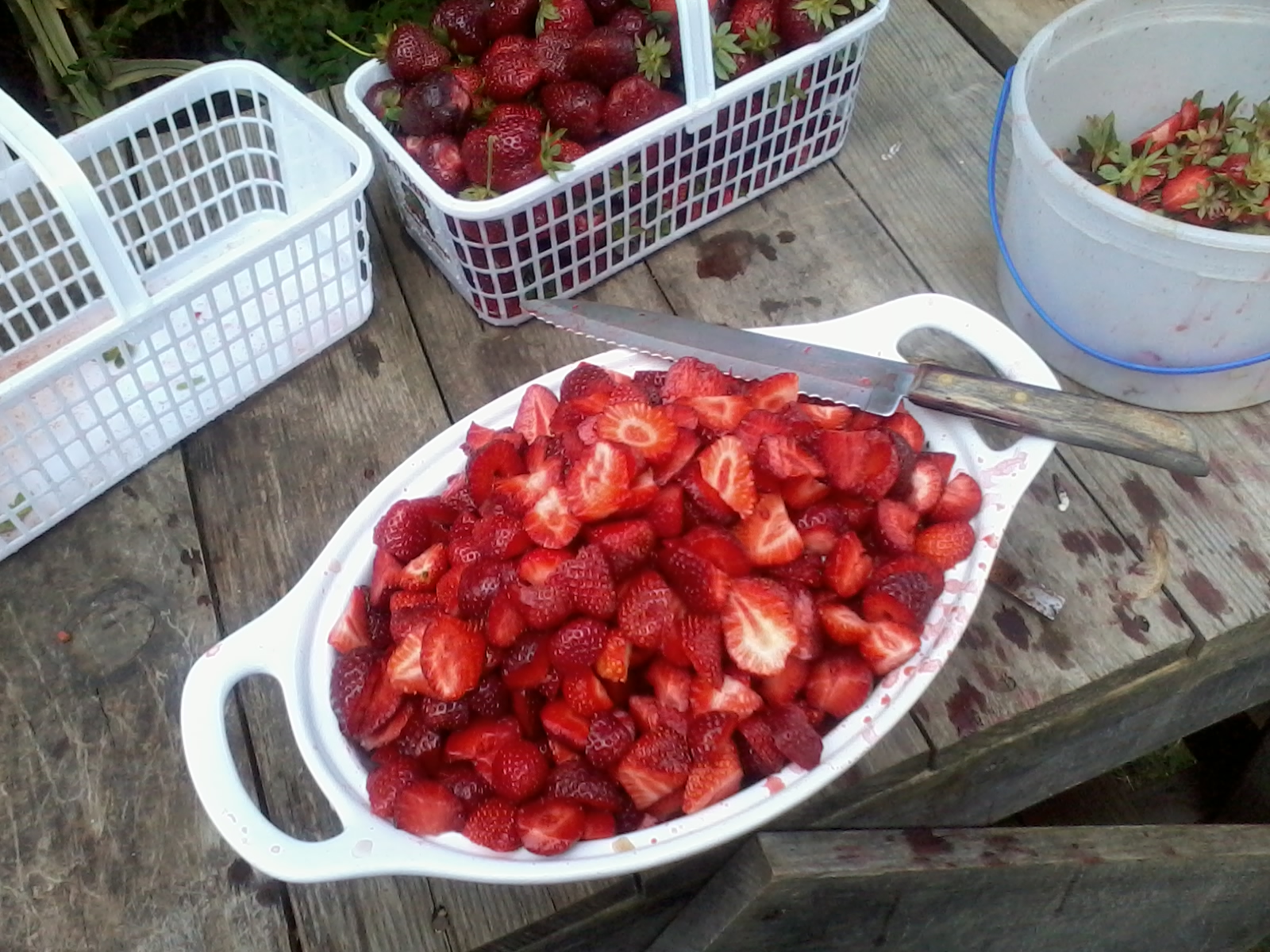
3 gallons of strawberries waiting to be processed.
  

I cap and cut up all of the berries. The photo on the left is one gallon cut up and ready and the one on the right is all three gallons. 

The caps and any soft spots go into the compost bucket. Nothing goes to waste on the homestead. With any luck we may have some volunteer strawberry plants next spring. Everything we can put back into the soil, goes back to the soil. Any volunteer plants that come up I keep. These plants have proven that they have the ability to make it through the compost pile and the winter to grow in the area. These plants tend to be very hardy.

These caps will go into the compost pile.
 
If you are concerned with getting your hands messy, this is not the job or really even life for you. When processing strawberry jam you will get strawberry "blood" on your hands.


 All jars must be sterilized and the lids must be heated. I will not go into an actual recipe because depending on if you use pectin and the brand of pectin as well as whether you are making low or no sugar jam will determine not only the amounts of each ingredient, but also cooking times. The same basic principles apply no matter which recipe you use. I suggest you find a recipe you like and go for it. If you don't add enough pectin or sugar instead of jam you may end up with strawberry syrup. It still tastes great, especially on pancakes.


We now have 45 1/2 pints of strawberry jam. The owner of the farm said that here there will be berries for about the next two weeks. Depending on where you are in the country it is still not too late. With an ingredient list that reads berries, sugar, and pectin it is worth the effort. The plink of the jars as they seal give me a sense of accomplishment. You can do this. This may just be the start of you taking control of your food destiny.

Consider joining this page and following The Rural Economist on Facebook.  Look for posts from the Rural Economist on www.untrainedhousewife.com. Have questions send us a message at theruraleconomist@gmail.com

Keep It Rural


If you need a good starter kit. Here it is.