Showing posts with label gardens. Show all posts

Tuesday, July 14, 2015

Gardening Update and Interesting Observations


In the past I haven't done real well on letting you know how my experiments have gone in the garden. I would reference them in another post, sometimes even a year later, but I haven't gone into detail on the good and bad. That isn't good. This year I am going to do just that.

Weeding in the garden has been a breeze. The cardboard has worked great.  We have had to water a lot more than I would have hoped, we have been really dry. Even with the lack of rain, none of the plants have wilted. Just pulling back the mulch a little shows the soil is still damp.

I am actually thankful our garden is smaller than normal. My job has ramped up and I wouldn't have time for much more.

An Interesting Observation


Our primary garden has not had really any insect problems. In fact only one plant has shown any sign of insect damage and it was on the outer edge.

We have tommytoes and Roma tomatoes in a much smaller bed on front of the house. These plants have not been so lucky. I have pulled 23 tomato worms out of a bed that is only 4 foot by 8 foot. 

We planted flowers in with the tomatoes just like the main garden. The only major differences are location and this bed was not mulched. At this point, I cannot say that the cardboard and mulch are what is causing the difference, but that appears to be the case.

When dealing with these tomato worms, we used no chemicals. All I did was go to this bed every day and look over the plants, removed the worms, and dropped them in a bowl of water and dishwashing soap. After doing this for several days in a row, we have had no more problems.

What perplexes me about this observation is the fact that tomato worms do not come from the ground. They are the larva of a moth. If they came from the ground I could explain the difference, but at this point I have not rational reason for this. If you see a tomato worm that looks like below, leave it alone and let it live. The white eggs on the back of this tomato worm are actually from a wasp that is a predator of the tomato worm.


Even though our garden is small this year, our harvest is looking promising. I am looking forward to homemade spaghetti sauce and homemade ketchup. Talk to you soon.

Bringing Rural Back

I would like to hear your thoughts on this subject. Let me know either in the comments or on the forum.

Have something to add to this topic join the Forum on The Rural Economist. If you would like to contribute to the conversation we would love to have you join us. It is brand new, but I am sure it will grow. 


Subscribe to our mailing list

* indicates required


You can like The Rural Economist on Facebook follow on The Rural Economist on Gplus. We now have a YouTube channel and we cover all sorts of things. Hop on over and check them out, oh and don't forget to subscribe. I have just joined Instagram if you would like you can follow us HERE. We will be sharing several things over the next year, I hope to see you there. 

Check out The Rural Economist on Pinterest

Affiliate Link Disclosure: This post may contain affiliate links. I may receive compensation for links, endorsements, testimonials, or recommendations for any products mentioned on this blog. If you see something you are interested in, check them out. Thanks for your consideration.


Tuesday, September 2, 2014

The Art of Gardening: Building Your Soil a Book Review

 Cover of The Art of Gardening: Building the Soilh


As we are getting closer to fall many of you will be finishing with gardening for the year. If not you are thinking about fall and winter gardens. If you are not going to have a fall or winter garden then now is the time to start building your soil for the best garden you ever thought you could have next year.

Do you have questions about mulching your garden? Composting? Whether or not to till? Seed saving? Plant management? What to plant? If you said yes yo any of these I have the book for you. Susan Vinskofski has put a lot of time and thought into this eBook. The book is well laid out and beautifully illustrated. Illustrations are by Deb Hamby.

Have you heard of lasagna gardening? No I am not talking about growing noodles or even growing all of the ingredients for lasagna. It is a mulching and growing method for raised beds that is covered in depth in this book.

How about Back to Eden gardening? This is covered as well. Not only is it covered in theory, but materials and construction. Susan tells you why you should not till and how to have minimal weeding in your garden.
Susan covers the basics of composting and what types of mulch to use. Did you know there were mulches that are not suggested for a garden?

There is a small discussion on the difference between open-pollinated, hybrid, and GMO seeds. Why you might choose one over the others and the benefits and drawbacks of each.

I really like the fact that she tells us how to save seeds from an heirloom tomato. She includes step-by-step instructions on how to test a seeds viability and how to determine germination rate.

Should you start seed indoors? If so when? Maybe you should buy plants. How about direct sowing if seeds? All of these are discussed with links to charts that will help you determine when to do what based on your agricultural zone.

Susan covers a good range of both cool weather as well as warn weather veggies. She even includes recipes for mist of the veggies covered.

Thus is a very good book for the beginner and the intermediate gardener and would be invaluable to the experienced traditional gardener who is considering alternative growing methods.

If you would like more information about this book you can follow this Link.

I hope you are working toward your

Rural Dreams and Homestead Wishes


Subscribe to our mailing list

* indicates required

You can subscribe to The Rural Economist by email by simply filling out the form above. Your information will never be sold or given to anyone else. You can like The Rural Economist on Facebook follow on The Rural Economist on Gplus. Or you can even follow The Rural Economist on Pintrest. 

Monday, May 19, 2014

Praying Mantis A Garden Hero?


I regularly run into people who honestly think that every insect in the garden is bad. They try to make it their mission in life to have their garden a bug free zone. Some you can reason with others you cannot. Many insects are not only allowable in the garden, some are extremely helpful.

At times the Praying Mantis could be considered one of the "Guardians of the Garden". At other times the mantis is just a transient visitor. It is a cool insect and freaky all at the same time. A lot of people are afraid of them because they look so "evil".

The praying mantis is an ambush predator and will feed on anything smaller than itself but large enough to get it's attention.

When I say anything I mean anything. Tomato worms? Check. Potato beetles? Check. But at the same time honeybees, lacewings, and really anything. In fact, some species in the tropics have been known to eat rodents, frogs, and small lizards.

If there are not enough insects for them to feed on they will simply go somewhere else. The praying mantis can be helpful when you have an infestation but are really never harmful.

The mantis has great camouflage and can hide in plain sight. It captures it's prey with two spiked front arms and just rips it apart and devours it.

Cool insect, hero at times, neutral at others. I hope you enjoy these posts on insects.

May you achieve your
Rural Dreams and Homestead Wishes

Friday, April 25, 2014

Want to Learn to Pickle?

Pickling is one of the skills once you learn it you will use it over and over again. If you do not have someone who will teach you, you will want a clear concise tutorial. Enter A Primer on Pickling. This short little eBook covers everything you need to know to get started pickling.

A Primer on Pickling covers a little on the history of pickling to show how long this process has been used as a form of food preservation. Homestead Dreamer shows that pickling is still a viable and tasty form of food preservation for today.

Homestead Dreamer covers all of the equipment you will need for fresh pack pickling and includes four recipes for pickles. You do not even have to have a pressure canner for the pickles she covers.

If you are just getting started you cannot beat this little book for only $1.99. Check it out on Amazon. You can click the image above or it is even in The Rural Economists Amazon Store. You can access The Rural Economist Amazon store on mobile by clicking where it says home at the top and selecting the store or by selecting the astore to the right.

Hopefully this will help you have...
Rural Dreams and Homestead Wishes

You can subscribe to The Rural Economist by email by simply filling out the form at the top right of the page. Your information will never be sold or given to anyone else. You can like The Rural Economist on Facebook. Or you can even follow The Rural Economist on Pintrest.

Other equipment you might need. 


This post contains affiliate links. 

Saturday, April 19, 2014

Farming on "New Ground"


The term new ground refers to an area that has not been previously cultivated or has not been cultivated in several years. New ground can be former pasture, brush land, timberland, or even non chemically treated lawn. New ground had major benefits as well as some serious challenges. We will cover both.

If you talk to any old timers they may tell you about new ground that has been in cultivation for years. What they really mean is it is the newest ground they have.

Benefits of New Ground

Most of the time new ground has not been contaminated by chemicals. As I said before this may not be true if turning a section of lawn into garden space. The chemicals approved for use on lawns are way more harsh than most approved for food production.

Most times new ground will be extremely fertile. Leaves or grass clippings are often left to decompose wherever they fall. This of course increases the organic content in the soil, which invites earthworms and a whole host of beneficial microbes.

New ground can be very mellow. It may not have ever been impacted by tillers or heavy equipment. Mellow ground is easily worked, holds water well (needs less irrigation), and is just easier for your plants' roots to get around in.

New ground has most likely not been contaminated with diseases. New ground normally has a wide range of biodiversity which inhibits many vegetable diseases and helps control many pests.

Challenges of New Ground

New ground is very labor and time intensive. Getting my area to the point is is now has taken me 10 months. This has been me working on it a little at a time, an hour here and 6 hours there. All but about 5 hours were done completely by hand. A buddy of mine brought his tractor over for half a day. Everything else was done by hand.

Weeding new ground in the first year is a beast. It does not matter what the ground was before, there are bound to be hundreds of seeds and roots waiting to grow in the middle of your vegetable patch. This can be a constant fight, and can turn into a battle of the bramble if you will.

When you have wonderful, fertile new ground, you will want to at least keep it as healthy as it was and hopefully make it healthier. Direct sunlight to soil can kill the top levels of beneficial insects and microbes. Many plants take nutrients from the soil. The answers are simple mulching, composting, rotational planting, and if needed organic fertilizers. I will provide links for each of these topics, as this is beyond the scope of this post.

My New Ground


My new ground started out covered in privet and honey suckle. It took me nearly a year to get it to the point where I could plant anything in it at all. I cut even with the ground anything I couldn't pull up. Burned all of the brush that was too large to go through my chipper. Raked everything I could and am constantly pulling what feels like thousands of honey suckle and wild blackberry roots.

I am out in the garden everyday hoeing to stop any weeds from getting too far. As the plants I want get bigger I will be putting down cardboard and mulching with a mixture of pine shavings, wheat straw that was at the bottom of the chicken brooder area, and compost. This will go a long way to stopping the weed invasion, will prevent moisture loss, and will breakdown and actually improve the soil.

By taking in this new ground I increased my food production area by a little over 3 times. I am hoping to provide updates in the months to come.

For more information related to this topic you can read the following articles.
The Lowdown on Compost
Chinese Privet Homestead Hero or Villain
My Experiments with Hugelkultur and No Till
Lasagna Gardening
Instant Garden

You can subscribe to The Rural Economist by email by simply filling out the form at the top right of the page. Your information will never be sold or given to anyone else. You can like The Rural Economist on Facebook. Or you can even follow The Rural Economist on Pintrest.

This post shared on the following blog hops: Simple Saturday Blog Hop

Saturday, April 5, 2014

Is Gardening Becoming Essential for Survival


The picture above looks just like our local grocery store on a daily basis. We have stopped even walking in the building because we know the attempt at buying almost anything there will be futile. The management keeps telling everyone that they are trying to change warehouses. This may be true, but in the meantime everyone is having to go else where to get even the necessities. This started me thinking. What if we couldn't just go a couple of miles to another grocery and get the things we need? What if prices jump suddenly and we couldn't afford enough to provide the things we are used to consuming?

If you have anything to do with buying groceries around your place you have no doubt noticed price increases. On some items these increases have been quite dramatic. Beef has gone up a good bit in recent months and promises to continue to go even higher.

I cannot tell you the number of times I have heard "I spent too much at the grocery store today" or " I spent $70.00 and really didn't get anything". What do you do to off set the ever increasing prices of just eating?  This is one of the expenses that there is no way for you to get rid of. If you were to try to stop eating you would not live for very long.

Gardening going viral?

I have heard more and more people lately say that they wanted to produce 100% of their own food. While this is an incredibly honorable goal, I do not think this is very possible. Let me explain. We live on the edge between agricultural zone 7 and 8. There are several fruits that we like but are either too cold or to warm to produce. If we wish to continue to enjoy these fruits we will need to buy or trade for them.

We live on 1/2 acre so we do not have room to raise cattle or pigs. We do have a small laying flock and are planning on raising broiler chickens, but that puts us pretty close to our limit due to space.
My goal this year is to produce at least 30% of our food for the year. This will actually not reduce the amount of money we will spend on food. This will however free up some money we were going to spend anyway for higher quality items like beef or pork.

This year I am starting all of my plants from seed. Depending on where you live you could either put your seeds straight in the ground now or start your seeds indoors. Even if you only get a weeks head start you will still be ahead of the game.

My decision to start everything from seed is purely economics. Many plants you buy are $3.00 each or more. For less than $2.00 you can get enough seeds to start many plants. If you learn to save seed, your expenses really go down to next to nothing. My germination rate on tomatoes is nearly 100%. Jalapenos about 90% and Belle peppers about 75%. Not bad. I will be sowing squash, zucchini, corn, and really everything else straight in the ground.

If you have a knack for growing plants you can start a cottage business with a very small greenhouse just by starting seeds a couple of weeks before you can safely transplant outside. Start more that you will need or want and sell the rest. Even if you sell the plants for $2.00 each, the people that buy from you will be saving money and you will be earning a little extra with very little additional effort. This will help not only you, but your entire community.

Making it till you get a harvest.

Many folks have to worry about today while preparing for tomorrow. Many states have a program so those in food stamps can use them at the local farmers market. This gives people of limited income access to better quality food while they are learning and starting to produce their own.

Our church has become a pickup point for One Harvest Food Ministries. One Harvest is not a hand out. It is group buying. You are basically buying your food at whole sale price. Each month One Harvest has different menus you can choose from ranging from staples to just meats. While this option does not deal with the problems of chemicals used in growing the food, it can provide needed relief from food costs. Everyone can use a little help with food costs.

I see promise.

We live in an area that would best be described as semi rural. Very few HOAs, most everyone has a little space they can call their own, and there are very few if any restrictions on what you can do on your own land. The other day I came home from work early. Early enough in fact that I was able to pick the children up from school. On my way home from picking the kids up from school I noticed that somewhere between 1/3 and 1/2 of the homes were preparing a garden spot. This is great!

I work at Lowe's Home Improvement as my primary occupation. I see people everyday buying vegetable seeds or plants, fruit trees and berry bushes. I am able to talk to many of these people and about 20% say they are putting in a garden for the first time. Some are gardening due to the fact they are concerned about the quality and the amount of chemicals that are on the food at the grocery store. Others are trying to save money. Some even say that if you want to eat you had better grow it yourself.

The tide is slowly turning back toward more self reliance and I am proud to be able to say that.

Be sure and check out our affiliates for anything you might need. You can like The Rural Economist on Facebook. We are back at it full force. Please add yourself to our email list by filling out the form to the top right. Your email will not be sold or given to anyone else. You can also check out these posts that are related to this topic.

What to do if You Cannot Grow a Garden
.Becoming a Homestead Ambassador
Backyard Farming on an Acre (more or less) This Title available on The Rural Economist Amazon Store

May you all have Rural Dreams and Homestead Wishes.


Simple Saturday HopHeritage Homesteaders HopBackyard Farming Connection HopFront Porch Friday


Melissa K. Norris Pioneering TodayThe Chicken ChickThe Self Sufficient HomeAcre

Saturday, November 9, 2013

Rural Wisdom and Know How #1

News From Around Carter Homestead:

Here in the South the weather is chaotic, one day the high will be the low 50's and two days later the mid 70's with night time lows ranging from upper 20's to low 60's. Our weather makes things interesting. For tonight at least I am sitting by the fire.

My wife is in full on "Let's get this Christmas shopping done" mode. Most of the shopping has been done on Amazon so far. She is incredible. No procrastination going on with her.

We have two birthdays this week both my wife's mother and mine. We also found out that my wife will be having to work Thanksgiving day and the weekend before, so we will be having to get creative in our celebrations this year.

I would like for this to turn into a real conversation. I would like to get to know all of you and give you a chance to get to know my family and myself. In that spirit I am going to post some questions each week and give my answers. I would like for you all to answer the questions in the comments.

(1) As we are coming up on Veterans Day, are there any veterans in your family?
(2) Do you do anything to celebrate Veterans Day?
(3) Have you started your Christmas Shopping?
(4) When do you start listening to Christmas music?

My answers (1) I am a veteran as are both of my grandfathers. Both of my grandfathers served during WWII. I have my paw paw's WWII flag that was on his casket and his father's WWI flag. (2) Sadly, I do not do anything special. I will have to work. (3) My wife is on this with a vengeance. (4) I listen to Christmas music anytime the mood strikes me February or even July is fine by me. My wife thinks it should wait till the day after Thanksgiving. Now it is your turn.
The Rural Economist


We have a giveaway going for copies of two eBooks. The Urban Chicken and The Gardening Notebook. You can enter for this giveaway either on the posts about these books or on The Rural Economist Facebook page. We are looking forward to hearing from you.

Saturday, November 2, 2013

The Gardening Notebook a Review and Giveaway

The Gardening Notebook

Angi Schneider of www.schneiderpeeps.comwww.thegardeningnotebook.com, and www.thebusymomsguide.com is offering this wonderful ebook giveaway to help celebrate The Rural Economist's one year anniversary. As you can tell by the list above Angi is a very busy lady so I am honored that she thought enough of The Rural Economist to do this for all of you and for us as well.

This book is a real workhorse if you are planning to have a garden or just want to make your garden better each year. What Angi has done is make a easy and logical way to track your successes and failures. 

Angi has included several suggestions on how you can start working your way toward being more organic, how to keep weeds down in the garden, composting, saving money, and even what plants you should not plant close to each other, as well as what plants benefit each other by planting close.

For each plant Angi included in the book she has included tips as to what helps that plant grow best and covers the common pests and how to deal with these pests. The Gardening Notebook is designed as a tool with printable pages that should be kept in either a folder or three ring binder. This means the longer you use it the more valuable it becomes. 

Now for the best part; not only has Angi allowed me to give away two copies of The Gardening Notebook to celebrate our anniversary, she has also extended a 30% discount to all of The Rural Economist's readers. If you decide to buy The Gardening Notebook please realize that the 30% discount will expire on November 13th. Please follow the link below to purchase your copy and use the discount code RURAL at checkout to receive your 30% discount.Click here to visit Angi Schneider. This book normally retails for $9.95 but until November 13th you can get this eBook for only $6.97.What a deal!

If you would prefer to try to win a copy of this eBook first there are two ways to enter. (1) Follow The Rural Economist by clicking the Join This Site button and leave a comment on this post. (2) Follow The Rural Economist on Facebook by clicking HERE. Comment on the post about this giveaway with the tagline which I include on every blog post I make. Here is a hint- it will be the only thing in italics.

This book will help you keep a better garden which will enable you to....

Keep It Rural

Remember the giveaway will be November 11th. I will post the winners on here as well as on Facebook. The discount code is now active and will expire on November 13th.

There is a contest running between homestead bloggers. If you like The Rural Economist you can vote for us here. Just find The Rural Economist and click "like" Thanks.

Sunday, October 6, 2013

Chinese Privet Homestead Hero or Villian


I am in the process of trying to reclaim a strip of our homestead back from Chinese Privet. Chinese Privet is a highly invasive and quick growing species. On an interesting note, while trying to do research for this post I looked up this plant on the US Department of Agriculture site and it was not operational because of the government shutdown. HA HA.

Chinese Privet (Ligustrum sinense) is an evergreen shrub- even though it can reach a height of over 25 feet. Privet is propagated by seeds which can be spread by birds, by cuttings, and by new plants growing from the parent plants roots. Chinese Privet is a member of the olive family and is considered toxic to many animals. I have, however seen cows, horses, goats, and deer eat this plant with vigor and no negative results. When this plant is in bloom it is often covered with honey bees. I read in one place that privet blooms produce a bitter honey, but I have not found this to be the case.

 I am trying to clear a strip about 10 feet wide and 110 feet long or 1100 square feet. That is a good bit of ground no matter the size of the area you have. If you are like us and are working with a 1/2 acre homestead 1100 square feet is a huge part of your land. I have some plants that their trunks are close to 6 inches in diameter. The area is very thick with privet so there is a lot of biomass that will be accumulated. I cannot stand the thought of that much of a resource going to waste.

 I have used dead privet for wood in a camp fire, so that was my first thought. After a very brief internet search I found I was not the only one. In fact, it is reported that privet burns hotter than hickory. So the larger pieces can be used for firewood. I also thought about maybe using privet for carving. It cuts fairly well when green, but clogs anything other than straight edged tools. I do not suggest using a rotary tool on privet while green. Privet dries solid and hard. Based on my experience I would say it dries almost as hard as dogwood and is not easy to work at all.


Now we are down to just having to deal with the tops. We had a wood heater when I was a child and we never had enough small wood so I cut firewood to a much smaller diameter than a lot of people. What I have left to deal with is generally only a little larger in diameter than my thumb. Enter the small electric wood chipper. I had been looking for a wood chipper for a while, even tried to borrow or rent one and no one had one. I finally found one used. I will have a link to one that is very similar to mine at the end of the post. With the wood chipper I am able to turn what is left of the bushes into a very nice mulch/compost ingredient. As of right now I have 2 fairly large piles of wood chips waiting to be assigned their new duties. As I said above,privet dries hard and I have found that my chipper has a much easier time of grinding what is left while it is still green. It will take me a while to get it all done but I have figured out a way to use every part of the bushes I am taking out.


Here is the link I promised to an electric wood chipper. As you can see they are fairly affordable.


In everything you do try to minimize waist. In everything you do remember to...
Keep It Rural

By Gregg Carter

Monday, August 19, 2013

Backyard Farming on an Acre (More or Less)


As I sit here there is a tinge of fall in the air. In fact this is the third day in a row where it has felt like fall and that is really strange for August. This morning I fed the chickens, gathered the eggs, checked the garden (I will have to cut okra when I am done here), got a couple of loads out of the old house, and split some firewood. My wife says that I peck at things till they are done. She laughs and says I am a pecker. Guilty as charged. I gradually peck at all of the projects I have working until I get them done. I do this with almost everything including reading.

As summer growing season is winding down, the time to start planning the fall and next springs gardens draws near. My wife and I had a long talk about what we are going to grow next summer. I have never really had much of a fall garden, that is until this year.

I have been reading the book Backyard Farming on an Acre (More or Less) (Living Free Guides). This book has inspired me to really expand my fall garden and I would like to share why it is a good read for anyone who is interested in having a homestead lifestyle. The book was written by Angela England. She really put a lot of time into research for this book. This is not just a gardening book. It is a lifestyle book.

Angela describes some of the reasons that producing at least some of your food is a good idea. She talks about the lack of nutrition in many of the foods we buy at the grocery store, the health and cost benefits of producing as much as you can. You do not have to go into the homestead lifestyle with both feet. Start small if you need to, be sucessful do more each year. Just do something.

There is a chapter on selecting a homestead and one on homesteading where you are now. Angela has included possible layouts for one quarter, one half, and a full acre. Her designs are very functional and asthetically pleasing as well. These designs are not set in stone and can be customized to fit each persons situation.

Angela covers the tools that would be needed on a homestead and basic skills that should be developed. She does a very good job of covering fencing and outbuilding that the homestead is likely to need. She does not include any plans for building because those are so situation dependent.

Angela does an excellent job of covering many types of fruits and vegetables, tips on growing these varieties, several recipies in which to use your produce and ways to preserve much of your produce for the winter and early spring. She was so thorough with her coverage of things that could be grown in the fall and winter that I am going to be planting a full fall garden this year for the first time in years.

There are chapters on keeping chickens, rabbits, sheep and goats, and beekeeping. You can tell that this book was written with an eye on trying to be as self sustainable as possible. I do not know if I will ever talk all of my family into the idea of raising rabits or goats for food, but the information is here to get someone started.

I was very impressed with the section on Crafting from the Backyard Farm. This section focuses on trying to create an income from your homestead. This is a topic that I feel that many people overlook. It is very difficult if not impossible for one family to be self sufficient. By producing things that can be sold or traded on the homestead, we can add a level of sustainability. Doing this gives us the ability to buy or trade for things that we cannot produce.

In the appendeses there are plans for cold frames, to extend the growing season, plans for a chicken coop, and plans for a sheep or goat shed. There are also gardening journal pages which can be copied and used for the next several years. Angela also included references to all of the organizations that she referenced in the book.

Scattered throughout the book are important points. Some are called Over the Garden Fence. These are tips on how to do things easier or ways to save money. Some points are called Thorny Matters. Thorny Matters are warning about things to avoid. Other points are called On a Different Scale. These points are just other ways of doing things, I have found that I tend to do quite a few things that were listed in the On a Different Scale.

This is a great book for the beginner or intermediate homesteader and is written in a way that even people who have been gardening their whole life will learn or in some cases relearn things that will really help them produce more of their families food.

Backyard Farming on an Acre (More or Less) is just one more way, no matter where you live, that you can...

Keep It Rural

Sunday, June 2, 2013

Strawberry Jam Canning's Gateway Drug


If you're really going to embrace the homestead lifestyle just growing your own fate is enough. You must learn how to preserve your harvest. Canning is a time-tested and very reliable means of preserving a lot of your excess produce. In my opinion one of the easiest things began is strawberry jam. Since strawberries are one of the first things to get ripe in the season it's also good place to start learning that way you don't waste any time.

When I was growing up canning was a family adventure. Everyone got involved in some way. Most of the time my job was picking the fruit and cutting it up. Then Mom or Dad would do all the cooking and canning. Our kids had a lock in at our church, so they went to bed after I picked them up,meaning less hands to help. Even though my wife worked a 12 hour the night before she still came to help me pick before going to bed. We picked 3 gallons of strawberries. We picked ours at a local "you pick" farm that has not only strawberries, but also blackberries.
 After we got home I washed the strawberries. My wife says it is to get the bug pee off the berries, but honestly it is to get the dirt off. I just wash them with the garden hose and set them on my work table.  I have a worktable outside for doing a lot of the prepping. I believe that this helps me keep from messing up the kitchen as bad.
3 gallons of strawberries waiting to be processed.
  

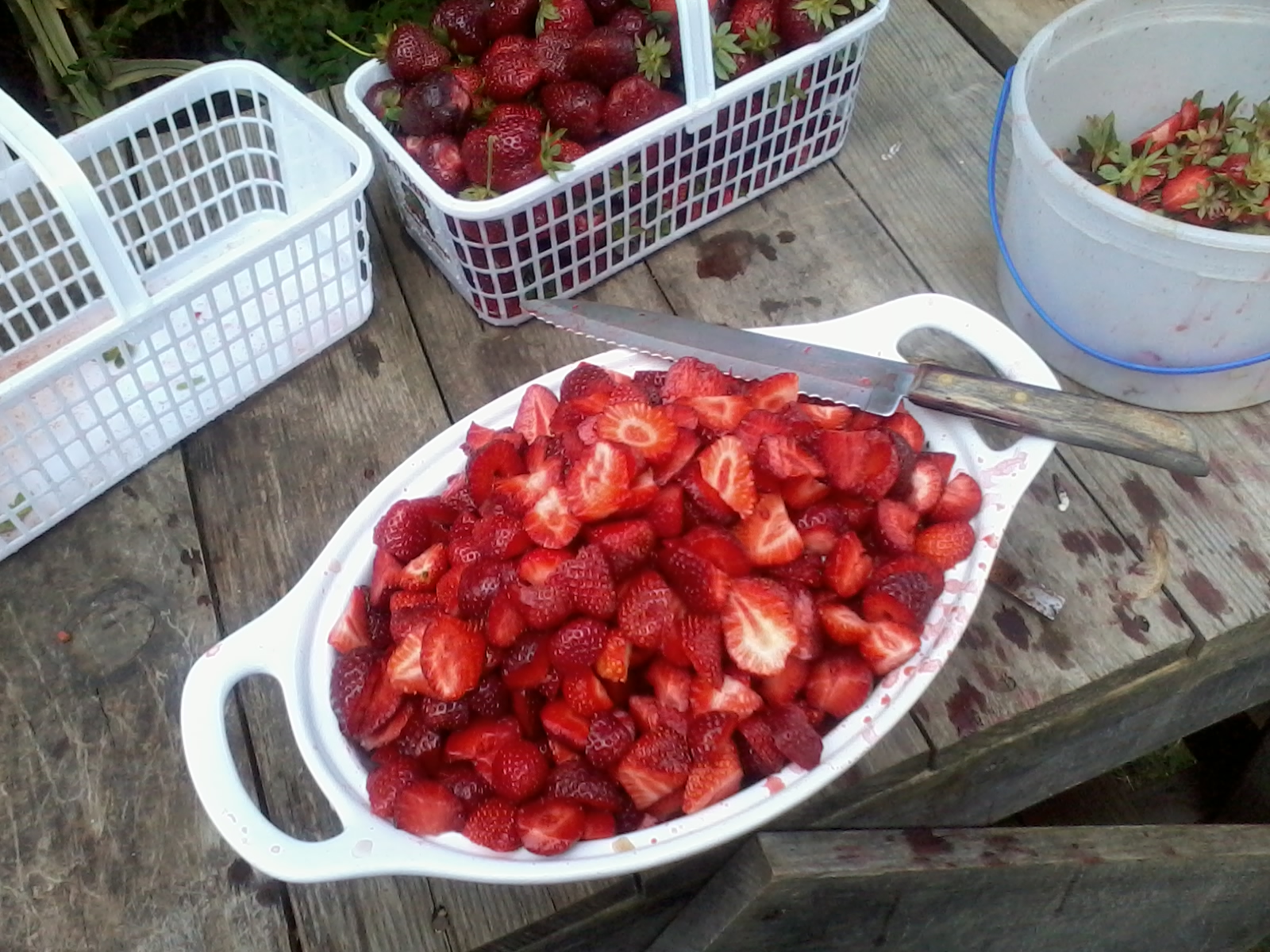
I cap and cut up all of the berries. The photo on the left is one gallon cut up and ready and the one on the right is all three gallons. 

The caps and any soft spots go into the compost bucket. Nothing goes to waste on the homestead. With any luck we may have some volunteer strawberry plants next spring. Everything we can put back into the soil, goes back to the soil. Any volunteer plants that come up I keep. These plants have proven that they have the ability to make it through the compost pile and the winter to grow in the area. These plants tend to be very hardy.

These caps will go into the compost pile.
 
If you are concerned with getting your hands messy, this is not the job or really even life for you. When processing strawberry jam you will get strawberry "blood" on your hands.


 All jars must be sterilized and the lids must be heated. I will not go into an actual recipe because depending on if you use pectin and the brand of pectin as well as whether you are making low or no sugar jam will determine not only the amounts of each ingredient, but also cooking times. The same basic principles apply no matter which recipe you use. I suggest you find a recipe you like and go for it. If you don't add enough pectin or sugar instead of jam you may end up with strawberry syrup. It still tastes great, especially on pancakes.


We now have 45 1/2 pints of strawberry jam. The owner of the farm said that here there will be berries for about the next two weeks. Depending on where you are in the country it is still not too late. With an ingredient list that reads berries, sugar, and pectin it is worth the effort. The plink of the jars as they seal give me a sense of accomplishment. You can do this. This may just be the start of you taking control of your food destiny.

Consider joining this page and following The Rural Economist on Facebook.  Look for posts from the Rural Economist on www.untrainedhousewife.com. Have questions send us a message at theruraleconomist@gmail.com

Keep It Rural


If you need a good starter kit. Here it is.

Monday, May 27, 2013

What To Do If You Cannot Grow A Garden

 Photo: Zukes blooming.
I am blessed, because nearly everyday I come in contact with someone who tells me they're starting their first garden ever. But every now and then, someone tells me that they cannot have a garden because of where they live. They want to have a garden, but do not know how to do it without getting in trouble. So I ask myself," How would I go about starting a garden with these restrictions?" I did a little research, and here's what I've come up with as suggestions for those who cannot have a garden.

Covert Gardening

There are several places that are  against a vegetable garden but are perfectly okay with a flower garden. In these locations I would practice covert gardening. There are many herbs that look perfectly at home in the average flower garden. Rosemary for example can be trimmed to look like many topiaries. Thyme can be used as a creeper right against your border. Basil, parsley, and oregano as well as many others can be used as a greenery in the average flower garden. There are also several very colorful varieties of lettuce, decorative cabbages, and kale. Most of the plants that I have listed above can be kept in a flower garden without raising a single eyebrow. If you're more adventuresome, I have seen peppers and even tomatoes designed for patios placed in a flower garden. You may want to slowly phase these in. Remember, every single step you take get you closer to being more self sustainable.

Container Gardens
Photo: Here's a creative wall garden for your herbs <3

Fresh Local Herbs ► 
http://www.farmerspal.com/organic-farms/produce/herbs/page/1/
Photo courtesy of www.farmerspal.com

So what if you're not even allowed to have a flower garden? Then we start to look at container gardens. Container gardens can provide a lot of flexibility. There are many varieties of tomatoes, strawberries, and even peppers there specifically designed for use with containers. Containers can be kept in the home, on the sidewalk, on the porch, or even on a patio. In warmer climates peppers are perennial not annual, so keeping them so you can leave them outside in the summer and bring them in during the winter. Pepper production is much greater the second year. Now, I'm not saying that you're going to want to grow corn and peas in a container but it is a start.

Community Gardens

This is a subject that every time I bring it up my wife has reservations because of the possibility of mismanagement. Community gardens are growing in popularity all across the country, so the likelihood of having one in your area is increasing every single year. A perfect setup would be that every person that works in the garden would get a percentage of the produce based on how many hours that person works or what kind of investment is made. If there is a community garden in your area, find out who the manager is. Ask questions. Here are some questions to consider asking. Is there a record of how much time is spent in the garden? Who decides how much each person gets off the produce? Who's responsible for the cost of seeds and for fertilizer? If for any reason these questions and more are not answered to your satisfaction consider passing.

If there is no community garden in your area, you can always look into starting one yourself ,that way you can make sure that it is managed properly. If you are in a small community, you might just have to go to the city council meeting. If you're in a larger metropolitan area ,you may have to deal with the city planner. There is precedent for this type of program so don't be afraid to ask.

Community Supported Agriculture or CSA

There are two types of CSAs. One you can just buy shares of the produce or the second, that requires a labor investment. Just like buying shares in a company there is some risk. Years when the growing season is great you can get a lot for your shares and years when the growing is poor you may not get much.

Many only want payment for shares, but if you ask around you may be able to find a CSA that will trade labor for part or all of the cost of shares. Most CSAs will provide a list of what fruits and vegetables they will provide for the share. Many will deliver their produce to you or you can pick it up at the farm.


Farmers Markets

The last option I will cover is farmer's markets. Farmer's markets are the least hands on of all the options that we have listed. Nearly all major cities and small towns have a farmers market. Farmer's markets are places where anybody who grows food can sell their abundance- provided they are willing to obtain a permit. Depending upon your location, you may have a wide range of options or very few.

This is again one of those situations where you will want to ask a lot of questions. Some questions I would like to ask are as follows: Do you use herbicides?, Do you use pesticides?, Are you certified organic?, and Are you willing to let me go look at your farm?This is not a complete list, but it is a good starting place.
Every step you take, no matter how small can be the beginning of your homestead. Just like the Victory Gardens in World War 2, if we all work together there can be food production at every household.


If you enjoy these articles please consider joining this page by clicking the join this page button to the right. You can also like the The Rural Economist Facebook page.

Remember to

Keep It Rural

Friday, April 19, 2013

My experiments with Hugelkultur and No Till

The weather here has been cooler and wetter than normal. I have finally gotten a lot of our garden in and I am excited about a several of my experiments for this year. So here we go with two of my experiments.

Things I am trying this year for the first time; I am going to try a modified Hugelkultur bed. Hugelkultur (hoogle culture) can be defined as the ultimate raised bed. The term Hugelkultur was first coined in Austria and is built by starting with a wood core and piling dirt on the tree trunks or stumps. This has been practiced since ancient times. Once completed the bed would be about six feet high and would be at a very sharp angle. The sides would then be cultivated with food bearing plants. Please see the image below.

Even in extremely dry areas irrigation is reduced to a bare minimum. The general consensus is that the wood core becomes spongy and retains water that is slowly released into the soil. Others believe that the wood core promotes a fungal network that works with the plant to harvest and utilize available water much more efficiently than other methods.

I have modified this type of agriculture. I did not mound the dirt. I dug a trench and buried the wood, then planted on top of where the wood is buried. I believe that this will produce excellent results. I have a couple of plants that are a control group. They are just planted in the ground the way I always have. I have 12 tomato plants in the ground. Six are planted above woody beds (I am not going to call them hugel beds because they are not). I also have six planted in the ground like normal. One is planted straight into the area where my last compost pile was and two are planted in the spot where my chicken tractor was. The remaining three have had no special preparation. I am also going to make my first attempt with no till. I am trying the no till only with the tomatoes as well. I mowed the area really good prior to planting. After I planted the tomatoes I surrounded them with cardboard as a weed barrier. I like cardboard better than landscape fabric because the cardboard breaks down much faster and actually helps improve the soil. (A thick layer of newspaper can be used in the same way.) On top of the cardboard I am mulching with wheat straw. The cardboard should stop grass and weeds from coming up around my plants. The wheat straw should help retain moisture and assist the cardboard in retarding grass and weed growth. Both of these resources will slowly breakdown and improve the soil quality.

Later I will mix compost into the wheat straw. This will allow nutrients from the compost to leach out and into the ground every time it rains and will speed up the break down of the straw. If this works like I think it will, I shouldn't have to weed very much at all and in the future I will only till when I am working new ground and even then I will not have to till the ground as hard. I will keep you all informed as to the progress of this experiment. Below are some additional resources if you would like to learn more about hugelkultur.
Please consider following this page by clicking the join site button to the right and follow The Rural Economist on facebook. Remember as always to....... Keep It Rural

For more information on Hugelkultur:


 http://joybileefarm.com/hugelkultur-using-waste-wood-to-build-a-raised-bed-garden/


Green Thumb Thursday Linkup

Sunday, March 31, 2013

Seed Banks A Way to Preserve Agricultural Diversity?

I was asked to write a post on seed banks so I started doing a little research. If you simply search for seed banks the two types of sites that come up most are for cannabis and survival seed kits. Since I know the person who asked me to write this fairly well, I am sure she was not asking about cannabis, and she is a pretty avid homesteader so I do not think she is asking about an apocalypse. So I am going to cover this from a biodiversity viewpoint. Seed banks are primarily concerned with heirloom or open pollinated plant varieties. Their goal is to maintain an adequate supply of these seeds in the event of a major natural or man made disaster.

 This would be a good time for a few Rural Economist definitions:

Open Pollinated Seed: a seed from a variety of plant that when the seed is saved from that plant will reproduce a plant true to its parent. These seeds will reproduce reliably season after season.

Heirloom variety: An open pollinated variety which has been cultivated for many years and has shown to be true to type.

Hybrid variety: The first generation of an intentional cross pollination of two different plants in the same plant family. These seeds if saved will have a very low percentage of offspring that stay true to type.

GMO: Genetically Modified Organism. There are a great and ever growing number of foods that have been genetically modified. Genetic modification occurs in a laboratory with biotechnology. DNA is introduced into a plant or animal from a different, many times unrelated organism. DNA from fish, scorpions, other types of plants, and even humans have been introduced into these new "super" seeds. Most of these seeds are patented so even though GMO seed saving is possible (I cannot understand why anyone would want to), it is illegal.

Monoculture: The practice of raising only one type of produce on a large tract of land i.e. corn, wheat, onions, potatoes, etc.

Poly culture: The practice of raising several different types of edible plants and/or animals in close proximity to each other.

Since the advent of industrial farming and the wide spread practice of monoculture the number of open pollinated and heirloom varieties has plummeted. When people stopped growing or at least buying their produce locally many of these old seed types went away. As people stopped buying their food from local producers industrial farmers took over. There are places all over the world that you can go and see hundreds of acres of corn and wheat. There are places where you can see dozens of acres of tomatoes or onions. When producing something commercially you want uniformity.

Hybrids were the first to start taking the place of the heirloom varieties. Hybrids have their place. Nature produces hybrids everyday without any assistance from people. A pollinator does not typically discriminate one type of plant from another. A honey bee will move from one flower to another regardless of plant type (this is why you should never plant your cucumbers too close to your watermelons. They will cross pollinate and the melons will not taste very good). When we go to the grocery store we expect all of the tomatoes to look exactly the same, heirloom varieties do not do this. The hybrid plants can be selectively cross pollinated to always produce results with standard size and color.

Now we have genetically modified plants. The most widely known of the genetic modifications is to make corn and soy capable of tolerating herbicides. Monsanto is the world leader in this research. They have made corn and soy that is "Roundup" ready. These varieties are patented by Monsanto as is Roundup. Monsanto has also made corn that produces a toxin in the kernels that protects the corn from ear worms. One big problem.Some research leads us to believe that this toxin could be what is killing the honey bees. Simple solution is just say NO to GMO.

Okay, so now back to seed banks. Seed banks have been set up in every major country in the world. They contain thousands of varieties of open pollinated and heirloom seeds. If a major event were to occur they would release these seeds to farmers so as to ensure there continued viability.

Some types of seeds are better suited to seed banking than others. There are types of seeds that can be stored for hundreds of years. There were grain seeds found the the Egyptian pyramids that were successfully grown. Other seeds can only be stored for a season or two. Onions are the most common short storage seed. The best idea is to find a group of people who share your interest in heirloom or open pollinated seeds and seed share. By doing this you do not have to have a freezer full of seeds or grow every type of seed you want to keep available. You can do this with friends, with your community or even on a much larger scale. A friend of mine gave me some okra seeds that had been in their neighbors family for over 40 years. I was honored to be given these seeds. I enjoy sharing seeds with people. If this is something that you would like to get involved in check out www.heirloomseedswap.com . This is a large community that is dedicated to preserving and spreading long term biodiversity by the way of sharing seeds.

Together we can

Keep It Rural

Remember to check out the People I Listen Too page, like The Rural Economist facebook page and follow this blog.

 Green Thumb Thursday Linkup

Sunday, March 10, 2013

The Low Down on Compost


Over the past several years there has been a growing interest in composting. Compost can produce a good organic fertilize for your plants. As well as reduce our dependence on chemical companies for fertilize and soil treatments, it will greatly improve the soil over time so that plants are less susceptible to disease and even common plant pests. Composting can and should be easy.

Just like everything else when there is a growing interest in a subject a lot of people try to find a way to make money off of people who are just getting started. There is every kind of compost bin, tumbler, and there is even a bio booster "designed" to speed up the composting progress. The truth is you can spend as little or as much as you want and be as basic or as fancy as you want. In fact, when I first started composting I just used a pile. Guess what? I ended up with  rich dark compost. All I did was add kitchen scraps when I had them and a shovel full of composted manure that I got from a neighbor. So if I could do that anyone can.

What You Can Compost:

Really you can compost ALL of your kitchen scraps except meat related scraps. The reasons you do not want to use meat byproducts are several; 1) meat byproducts smell 2) meat byproducts tend to attract unwanted insects 3) and they can induce disease into your food source. Everything else in the form of kitchen scraps are good to go.

You can compost a lot of the things that we throw out in the trash. Newspaper pages, not the glossy ads, shredded, paper bags, the kids old homework, old cotton clothing torn into shreds, even human and pet hair. All of these things can be included in your compost. These things add what compost geeks (hey I am one so don't judge) call brown ingredients.

Other things that can be composted include grass clippings, garden  byproducts (corn stalks or old plants) leaves, and herbivore manure. No carnivore or human manure should be included. These manures can be composted, but must be composted in a different manner to ensure that cross contamination. We have greatly reduced the amount of things that we put out with the garbage by composting. Simply put, composting can slow the growth of land fills.

Compost Method:

Compost Tumbler


The tumbler is the quickest method of producing compost. You have to mix browns (carbon heavy items)and greens (high nitrogen). Browns would be dry leaves, egg shells, tea bags, coffee grounds, or wood chips. Green items include things like grass clippings, left over lettuce, onion cuttings, and herbivore manures. These should be mixed half and half then watered to the point that the bulk is thoroughly damp, but not soaked. You will also want to add a shovel full of completed compost or compost starter. Once all of this is done, you will need to turn the tumbler a minimum of 3 times per week and if possible everyday. The tumbler is perfect for small areas. They can be made in something as small as a 5 gallon bucket. The output would be adequate for a small raised bed or several containers used for garden plants.

Compost Bin


Next step up in production is a compost bin. This will produce more than all but the largest compost tumblers, but the time from start to completion is increased as well as the amount of labor. In a compost bin it is more important to properly mix or layer the different types of ingredients. Remember the two types of ingredients are greens and browns. These terms have little to do with the color of the ingredients, manure looks more brown, but is a true green. The greens are items that are rich in nitrogen and the browns are primarily carbon. I would suggest if you are going to use bins have at least two. You will want to turn the bin about every three days for quickest results. You will still want to add a couple shovels full of either completed compost or rich soil to get the process started. During dry times of the year your bin will need to be watered. You want the bin to be moist not wet.

Compost Pile


The largest method we will cover is a compost pile. In order to achieve optimal temperatures in the center of the pile one would want the pile to be at least 3 feet high and 3 feet wide at the base with the same mixture of browns, greens, and rich soil or compost. Ideally these ingredients should be accumulated all at once and be turned or the pile moved from one place to another every 3 days. Moving the pile increases airflow in the pile and keeps it "cooking". These piles have been known to produce enough heat to keep a greenhouse warm enough to prevent delicate plants from getting too cold. All of the same rules apply to the pile as did the bin as concerning moisture. The only difference is a matter of scale.

Vermiculture


The last method we will discuss is the method I use. Worm compost or vermiculture. This can be done either directly on the ground or as a raised worm bed. I place mine directly on the ground. Do I lose some of the worms by them going down into the ground? Yes. Do I really care? No. Why? Because they are working the ground for me. Improving both the soils fertility and the aeration. I also move my vermiculture bed around my garden. This softens the ground where ever it has been placed. I add kitchen scraps nearly daily. I add all the new materials to one side. When I want to harvest some compost, I change the side I am placing the new items on. As the food (new items) are used up the worms migrate to the new food side. After a day or two I remove the compost from the old side collect the worms that are in the compost and either put them back into the system or go fishing. I still occasionally mix the pile, but it is not as labor intensive as the other methods. For me this is the best option.

Tools for composting:


If you choose the bin or pile methods you will need a compost fork. I do not advise trying to turn a compost pile with a shovel. You will work yourself a lot harder than need be. You will also need a source of water.Lastly, you will need time.

Now that I told you all of this, if you do not wish to manage your compost, just pile it up and wait. Nature has been doing this ever since it was set in motion. It will take a LOT longer without management, but it will still work. Compost can and should be another step toward getting chemicals out of our food.

Working toward a traditional Rural Lifestyle.


Subscribe to our mailing list

* indicates required


You can like The Rural Economist on Facebook follow on The Rural Economist on Gplus. We now have a YouTube channel and we cover all sorts of things. Hop on over and check them out, oh and don't forget to subscribe. I have just joined Instagram if you would like you can follow us HERE. We will be sharing several things over the next year, I hope to see you there. 

Check out The Rural Economist on Pinterest


Affiliate Link Disclosure: This post may contain affiliate links. I may receive compensation for links, endorsements, testimonials, or recommendations for any products mentioned on this blog. Any time you use one of our links for Amazon, if you purchase something The Rural Economist receives a small commission and it doesn't cost you any more. Even if you do not purchase the items I list. In this way you will help support us trying to teach people about self reliance and homesteading. Thanks for your consideration.