Showing posts with label food prices. Show all posts

Saturday, April 5, 2014

Is Gardening Becoming Essential for Survival


The picture above looks just like our local grocery store on a daily basis. We have stopped even walking in the building because we know the attempt at buying almost anything there will be futile. The management keeps telling everyone that they are trying to change warehouses. This may be true, but in the meantime everyone is having to go else where to get even the necessities. This started me thinking. What if we couldn't just go a couple of miles to another grocery and get the things we need? What if prices jump suddenly and we couldn't afford enough to provide the things we are used to consuming?

If you have anything to do with buying groceries around your place you have no doubt noticed price increases. On some items these increases have been quite dramatic. Beef has gone up a good bit in recent months and promises to continue to go even higher.

I cannot tell you the number of times I have heard "I spent too much at the grocery store today" or " I spent $70.00 and really didn't get anything". What do you do to off set the ever increasing prices of just eating?  This is one of the expenses that there is no way for you to get rid of. If you were to try to stop eating you would not live for very long.

Gardening going viral?

I have heard more and more people lately say that they wanted to produce 100% of their own food. While this is an incredibly honorable goal, I do not think this is very possible. Let me explain. We live on the edge between agricultural zone 7 and 8. There are several fruits that we like but are either too cold or to warm to produce. If we wish to continue to enjoy these fruits we will need to buy or trade for them.

We live on 1/2 acre so we do not have room to raise cattle or pigs. We do have a small laying flock and are planning on raising broiler chickens, but that puts us pretty close to our limit due to space.
My goal this year is to produce at least 30% of our food for the year. This will actually not reduce the amount of money we will spend on food. This will however free up some money we were going to spend anyway for higher quality items like beef or pork.

This year I am starting all of my plants from seed. Depending on where you live you could either put your seeds straight in the ground now or start your seeds indoors. Even if you only get a weeks head start you will still be ahead of the game.

My decision to start everything from seed is purely economics. Many plants you buy are $3.00 each or more. For less than $2.00 you can get enough seeds to start many plants. If you learn to save seed, your expenses really go down to next to nothing. My germination rate on tomatoes is nearly 100%. Jalapenos about 90% and Belle peppers about 75%. Not bad. I will be sowing squash, zucchini, corn, and really everything else straight in the ground.

If you have a knack for growing plants you can start a cottage business with a very small greenhouse just by starting seeds a couple of weeks before you can safely transplant outside. Start more that you will need or want and sell the rest. Even if you sell the plants for $2.00 each, the people that buy from you will be saving money and you will be earning a little extra with very little additional effort. This will help not only you, but your entire community.

Making it till you get a harvest.

Many folks have to worry about today while preparing for tomorrow. Many states have a program so those in food stamps can use them at the local farmers market. This gives people of limited income access to better quality food while they are learning and starting to produce their own.

Our church has become a pickup point for One Harvest Food Ministries. One Harvest is not a hand out. It is group buying. You are basically buying your food at whole sale price. Each month One Harvest has different menus you can choose from ranging from staples to just meats. While this option does not deal with the problems of chemicals used in growing the food, it can provide needed relief from food costs. Everyone can use a little help with food costs.

I see promise.

We live in an area that would best be described as semi rural. Very few HOAs, most everyone has a little space they can call their own, and there are very few if any restrictions on what you can do on your own land. The other day I came home from work early. Early enough in fact that I was able to pick the children up from school. On my way home from picking the kids up from school I noticed that somewhere between 1/3 and 1/2 of the homes were preparing a garden spot. This is great!

I work at Lowe's Home Improvement as my primary occupation. I see people everyday buying vegetable seeds or plants, fruit trees and berry bushes. I am able to talk to many of these people and about 20% say they are putting in a garden for the first time. Some are gardening due to the fact they are concerned about the quality and the amount of chemicals that are on the food at the grocery store. Others are trying to save money. Some even say that if you want to eat you had better grow it yourself.

The tide is slowly turning back toward more self reliance and I am proud to be able to say that.

Be sure and check out our affiliates for anything you might need. You can like The Rural Economist on Facebook. We are back at it full force. Please add yourself to our email list by filling out the form to the top right. Your email will not be sold or given to anyone else. You can also check out these posts that are related to this topic.

What to do if You Cannot Grow a Garden
.Becoming a Homestead Ambassador
Backyard Farming on an Acre (more or less) This Title available on The Rural Economist Amazon Store

May you all have Rural Dreams and Homestead Wishes.


Simple Saturday HopHeritage Homesteaders HopBackyard Farming Connection HopFront Porch Friday


Melissa K. Norris Pioneering TodayThe Chicken ChickThe Self Sufficient HomeAcre

Wednesday, November 13, 2013

A Family Tradition of Sustainability

My grandfather and my son shelling corn for corn meal.

Have you ever had the privilege to spend time with someone who lived through the Great Depression? Have you listened to their stories? Have you learned their lessons? I have been blessed to spend a lot of time with my grandfather. He still knows things that I am wanting to learn, but one thing he has taught everyone of his family that are willing to listen is being self sustainable. Today we are primarily going to talk about the family grist mill. Yep, our family owns its own grist mill. My dad and my grandfather bought the mill when I was in my teens. Our mill has been operated every fall for about 30 years. 

There is something special about eating things that have been grown and processed on your own or your families land. Not only do you know everything that has gone into your food, it tastes better too. Now I will tell you for me it is a really big bonus to know that my cornmeal was not sprayed with Roundup. It is also a big bonus for me to know that my cornmeal has not been drenched with pesticides.

                          
The first step to making corn meal is shelling the corn. Shelling is getting the dried kernels off of the cob. You can do this by hand, but having a sheller saves a lot of time. The sheller above is not the sheller that I used as a teen. The one above is a lot nicer than the one I have the most time on. The sheller I spent my youth operating was a single turn sheller, which means each crank of the handle only turned the sheller one time. The sheller I operated was the same one my grandfather used when he was a child. The one pictured above was purchased by my great uncle's father in 1934. That's right the machine pictured above is nearly 80 years old and still works great. See the video below. Warning all of the videos included in this post are really loud and are more for visual purposes only. There is no narration. 


After the corn is shelled it is dumped into the hopper. And the tractor is started. After the tractor is started the PTO power take off is engaged. The hopper feeds the corn to the stones. You can adjust how fine the meal is with a knob on the side. Warning do not operate an internal combustion engine indoors without having the exhaust vented or chimney ed to the outside. You will see the flue from the muffler of the tractor to the outside in the video below.


As was pictured in the video above and in the picture below. The ground meal comes out of a small chute and is scooped up and bagged. You cannot seal the bags at this point, because the meal is still warm and can sour if you do not let the meal cool before sealing.


In about 1 hour we produced a little over 100 pounds of cornmeal. We took home about 40 pounds. Not bad for spending time with my grandfather and my youngest son spending time with his great grandfather. He may never read this but, I am proud of my grandfather for many reasons. Teaching us to be self sustainable is only one of them. Granddad I salute you.


Now for the most important part. How do you use this cornmeal. I say homegrown, home ground cornbread is the best, but you do have to treat it differently. First and a very important step is this must be sifted to remove the bran. It is really tough eating if you skip this step. Below is the crank type sifter I like best. To me it just works better.

Here is our families cornbread recipe:
3 cups sifted corn meal
1 egg
3/4 tsp Baking Soda
1/2 tsp salt
Add just enough milk or buttermilk (depending on your taste I like either, but like buttermilk most) to make the mixture soupy.
Bake at 475 degrees for about 30 minutes until golden brown.

Now, I know there are no longer mills in every community, in fact I only know of three mills that are still in operation. Sometimes you can find a mill by going to your local farmers market and asking around. If you cannot find a mill you can get a smaller version that you can do your grinding at home. I am going to post a link to two mills. One is electric and fairly expensive but has a lot of good reviews and one is hand cranked.


My grandfather tells this story to everyone who will listen. When he was a kid he and his brothers shelled a bushel of corn and took it to the mill every Saturday. They ate cornbread and beans every day of the week and if they didn't have that they would not have eaten. We are blessed beyond measure today. 


Note: You can use field corn or even popcorn to make cornmeal. White field corn tastes a little different from yellow field corn and popcorn tastes different from both of them. You can buy all of them in bulk and save a lot of money. I believe you can find a grower of at least one of these corns close to you that do not use all of the chemicals and have a healthier food supply.

We can take back control of our own food supply, even if it is one person at a time.

If you enjoy these articles consider joining this site by clicking the join this site button to the right. You can also sign up for email updates by filling out the form at the top right and finally you can follow The Rural Economist on Facebook by clicking HERE.

In everything you do...

Keep It Rural
Black Fox HomesteadFrom The Farm Blog Hop

Monday, August 19, 2013

Backyard Farming on an Acre (More or Less)


As I sit here there is a tinge of fall in the air. In fact this is the third day in a row where it has felt like fall and that is really strange for August. This morning I fed the chickens, gathered the eggs, checked the garden (I will have to cut okra when I am done here), got a couple of loads out of the old house, and split some firewood. My wife says that I peck at things till they are done. She laughs and says I am a pecker. Guilty as charged. I gradually peck at all of the projects I have working until I get them done. I do this with almost everything including reading.

As summer growing season is winding down, the time to start planning the fall and next springs gardens draws near. My wife and I had a long talk about what we are going to grow next summer. I have never really had much of a fall garden, that is until this year.

I have been reading the book Backyard Farming on an Acre (More or Less) (Living Free Guides). This book has inspired me to really expand my fall garden and I would like to share why it is a good read for anyone who is interested in having a homestead lifestyle. The book was written by Angela England. She really put a lot of time into research for this book. This is not just a gardening book. It is a lifestyle book.

Angela describes some of the reasons that producing at least some of your food is a good idea. She talks about the lack of nutrition in many of the foods we buy at the grocery store, the health and cost benefits of producing as much as you can. You do not have to go into the homestead lifestyle with both feet. Start small if you need to, be sucessful do more each year. Just do something.

There is a chapter on selecting a homestead and one on homesteading where you are now. Angela has included possible layouts for one quarter, one half, and a full acre. Her designs are very functional and asthetically pleasing as well. These designs are not set in stone and can be customized to fit each persons situation.

Angela covers the tools that would be needed on a homestead and basic skills that should be developed. She does a very good job of covering fencing and outbuilding that the homestead is likely to need. She does not include any plans for building because those are so situation dependent.

Angela does an excellent job of covering many types of fruits and vegetables, tips on growing these varieties, several recipies in which to use your produce and ways to preserve much of your produce for the winter and early spring. She was so thorough with her coverage of things that could be grown in the fall and winter that I am going to be planting a full fall garden this year for the first time in years.

There are chapters on keeping chickens, rabbits, sheep and goats, and beekeeping. You can tell that this book was written with an eye on trying to be as self sustainable as possible. I do not know if I will ever talk all of my family into the idea of raising rabits or goats for food, but the information is here to get someone started.

I was very impressed with the section on Crafting from the Backyard Farm. This section focuses on trying to create an income from your homestead. This is a topic that I feel that many people overlook. It is very difficult if not impossible for one family to be self sufficient. By producing things that can be sold or traded on the homestead, we can add a level of sustainability. Doing this gives us the ability to buy or trade for things that we cannot produce.

In the appendeses there are plans for cold frames, to extend the growing season, plans for a chicken coop, and plans for a sheep or goat shed. There are also gardening journal pages which can be copied and used for the next several years. Angela also included references to all of the organizations that she referenced in the book.

Scattered throughout the book are important points. Some are called Over the Garden Fence. These are tips on how to do things easier or ways to save money. Some points are called Thorny Matters. Thorny Matters are warning about things to avoid. Other points are called On a Different Scale. These points are just other ways of doing things, I have found that I tend to do quite a few things that were listed in the On a Different Scale.

This is a great book for the beginner or intermediate homesteader and is written in a way that even people who have been gardening their whole life will learn or in some cases relearn things that will really help them produce more of their families food.

Backyard Farming on an Acre (More or Less) is just one more way, no matter where you live, that you can...

Keep It Rural

Sunday, June 2, 2013

Strawberry Jam Canning's Gateway Drug


If you're really going to embrace the homestead lifestyle just growing your own fate is enough. You must learn how to preserve your harvest. Canning is a time-tested and very reliable means of preserving a lot of your excess produce. In my opinion one of the easiest things began is strawberry jam. Since strawberries are one of the first things to get ripe in the season it's also good place to start learning that way you don't waste any time.

When I was growing up canning was a family adventure. Everyone got involved in some way. Most of the time my job was picking the fruit and cutting it up. Then Mom or Dad would do all the cooking and canning. Our kids had a lock in at our church, so they went to bed after I picked them up,meaning less hands to help. Even though my wife worked a 12 hour the night before she still came to help me pick before going to bed. We picked 3 gallons of strawberries. We picked ours at a local "you pick" farm that has not only strawberries, but also blackberries.
 After we got home I washed the strawberries. My wife says it is to get the bug pee off the berries, but honestly it is to get the dirt off. I just wash them with the garden hose and set them on my work table.  I have a worktable outside for doing a lot of the prepping. I believe that this helps me keep from messing up the kitchen as bad.
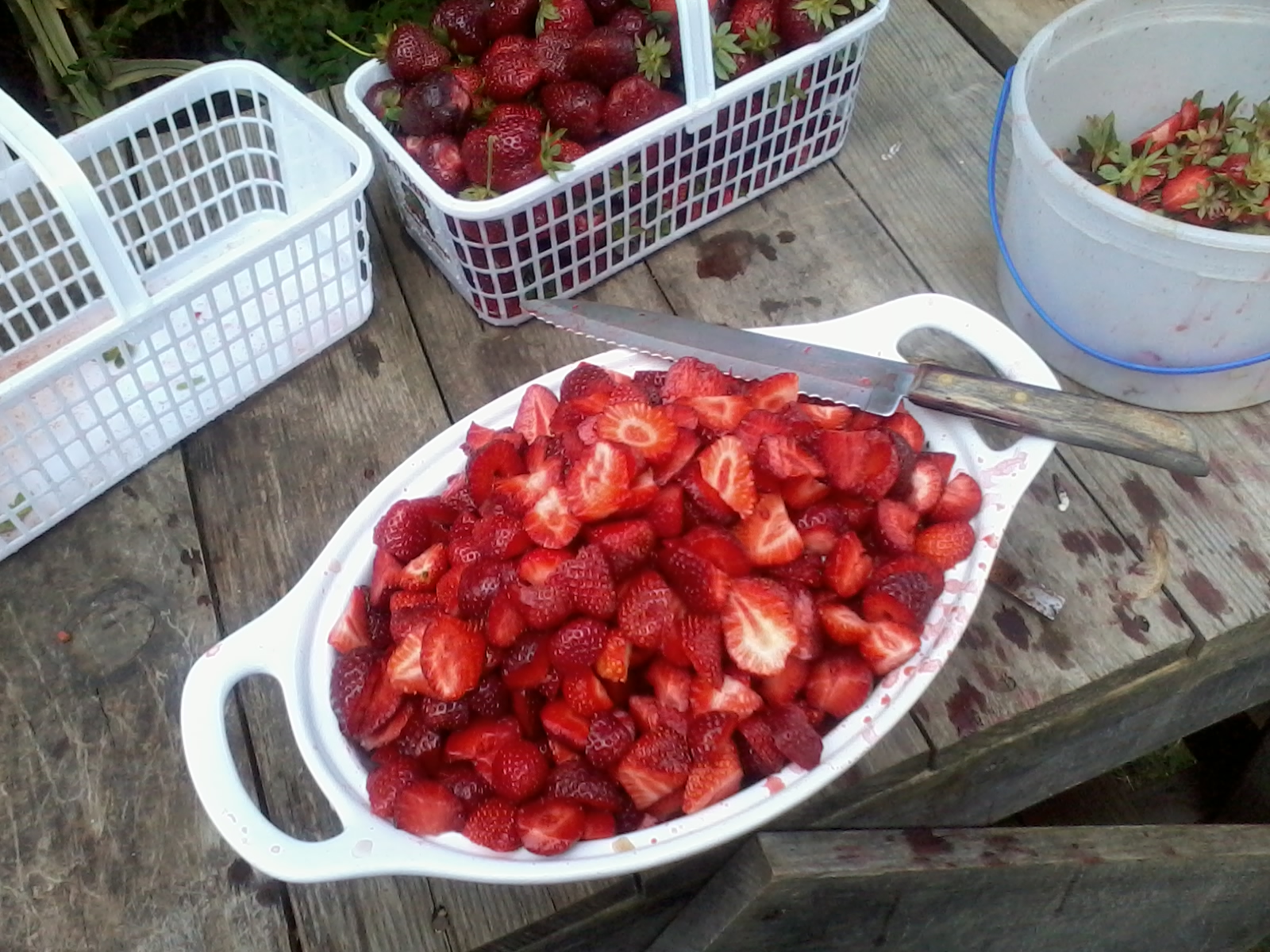
3 gallons of strawberries waiting to be processed.
  

I cap and cut up all of the berries. The photo on the left is one gallon cut up and ready and the one on the right is all three gallons. 

The caps and any soft spots go into the compost bucket. Nothing goes to waste on the homestead. With any luck we may have some volunteer strawberry plants next spring. Everything we can put back into the soil, goes back to the soil. Any volunteer plants that come up I keep. These plants have proven that they have the ability to make it through the compost pile and the winter to grow in the area. These plants tend to be very hardy.

These caps will go into the compost pile.
 
If you are concerned with getting your hands messy, this is not the job or really even life for you. When processing strawberry jam you will get strawberry "blood" on your hands.


 All jars must be sterilized and the lids must be heated. I will not go into an actual recipe because depending on if you use pectin and the brand of pectin as well as whether you are making low or no sugar jam will determine not only the amounts of each ingredient, but also cooking times. The same basic principles apply no matter which recipe you use. I suggest you find a recipe you like and go for it. If you don't add enough pectin or sugar instead of jam you may end up with strawberry syrup. It still tastes great, especially on pancakes.


We now have 45 1/2 pints of strawberry jam. The owner of the farm said that here there will be berries for about the next two weeks. Depending on where you are in the country it is still not too late. With an ingredient list that reads berries, sugar, and pectin it is worth the effort. The plink of the jars as they seal give me a sense of accomplishment. You can do this. This may just be the start of you taking control of your food destiny.

Consider joining this page and following The Rural Economist on Facebook.  Look for posts from the Rural Economist on www.untrainedhousewife.com. Have questions send us a message at theruraleconomist@gmail.com

Keep It Rural


If you need a good starter kit. Here it is.

Monday, May 27, 2013

What To Do If You Cannot Grow A Garden

 Photo: Zukes blooming.
I am blessed, because nearly everyday I come in contact with someone who tells me they're starting their first garden ever. But every now and then, someone tells me that they cannot have a garden because of where they live. They want to have a garden, but do not know how to do it without getting in trouble. So I ask myself," How would I go about starting a garden with these restrictions?" I did a little research, and here's what I've come up with as suggestions for those who cannot have a garden.

Covert Gardening

There are several places that are  against a vegetable garden but are perfectly okay with a flower garden. In these locations I would practice covert gardening. There are many herbs that look perfectly at home in the average flower garden. Rosemary for example can be trimmed to look like many topiaries. Thyme can be used as a creeper right against your border. Basil, parsley, and oregano as well as many others can be used as a greenery in the average flower garden. There are also several very colorful varieties of lettuce, decorative cabbages, and kale. Most of the plants that I have listed above can be kept in a flower garden without raising a single eyebrow. If you're more adventuresome, I have seen peppers and even tomatoes designed for patios placed in a flower garden. You may want to slowly phase these in. Remember, every single step you take get you closer to being more self sustainable.

Container Gardens
Photo: Here's a creative wall garden for your herbs <3

Fresh Local Herbs ► 
http://www.farmerspal.com/organic-farms/produce/herbs/page/1/
Photo courtesy of www.farmerspal.com

So what if you're not even allowed to have a flower garden? Then we start to look at container gardens. Container gardens can provide a lot of flexibility. There are many varieties of tomatoes, strawberries, and even peppers there specifically designed for use with containers. Containers can be kept in the home, on the sidewalk, on the porch, or even on a patio. In warmer climates peppers are perennial not annual, so keeping them so you can leave them outside in the summer and bring them in during the winter. Pepper production is much greater the second year. Now, I'm not saying that you're going to want to grow corn and peas in a container but it is a start.

Community Gardens

This is a subject that every time I bring it up my wife has reservations because of the possibility of mismanagement. Community gardens are growing in popularity all across the country, so the likelihood of having one in your area is increasing every single year. A perfect setup would be that every person that works in the garden would get a percentage of the produce based on how many hours that person works or what kind of investment is made. If there is a community garden in your area, find out who the manager is. Ask questions. Here are some questions to consider asking. Is there a record of how much time is spent in the garden? Who decides how much each person gets off the produce? Who's responsible for the cost of seeds and for fertilizer? If for any reason these questions and more are not answered to your satisfaction consider passing.

If there is no community garden in your area, you can always look into starting one yourself ,that way you can make sure that it is managed properly. If you are in a small community, you might just have to go to the city council meeting. If you're in a larger metropolitan area ,you may have to deal with the city planner. There is precedent for this type of program so don't be afraid to ask.

Community Supported Agriculture or CSA

There are two types of CSAs. One you can just buy shares of the produce or the second, that requires a labor investment. Just like buying shares in a company there is some risk. Years when the growing season is great you can get a lot for your shares and years when the growing is poor you may not get much.

Many only want payment for shares, but if you ask around you may be able to find a CSA that will trade labor for part or all of the cost of shares. Most CSAs will provide a list of what fruits and vegetables they will provide for the share. Many will deliver their produce to you or you can pick it up at the farm.


Farmers Markets

The last option I will cover is farmer's markets. Farmer's markets are the least hands on of all the options that we have listed. Nearly all major cities and small towns have a farmers market. Farmer's markets are places where anybody who grows food can sell their abundance- provided they are willing to obtain a permit. Depending upon your location, you may have a wide range of options or very few.

This is again one of those situations where you will want to ask a lot of questions. Some questions I would like to ask are as follows: Do you use herbicides?, Do you use pesticides?, Are you certified organic?, and Are you willing to let me go look at your farm?This is not a complete list, but it is a good starting place.
Every step you take, no matter how small can be the beginning of your homestead. Just like the Victory Gardens in World War 2, if we all work together there can be food production at every household.


If you enjoy these articles please consider joining this page by clicking the join this page button to the right. You can also like the The Rural Economist Facebook page.

Remember to

Keep It Rural

Sunday, March 31, 2013

Seed Banks A Way to Preserve Agricultural Diversity?

I was asked to write a post on seed banks so I started doing a little research. If you simply search for seed banks the two types of sites that come up most are for cannabis and survival seed kits. Since I know the person who asked me to write this fairly well, I am sure she was not asking about cannabis, and she is a pretty avid homesteader so I do not think she is asking about an apocalypse. So I am going to cover this from a biodiversity viewpoint. Seed banks are primarily concerned with heirloom or open pollinated plant varieties. Their goal is to maintain an adequate supply of these seeds in the event of a major natural or man made disaster.

 This would be a good time for a few Rural Economist definitions:

Open Pollinated Seed: a seed from a variety of plant that when the seed is saved from that plant will reproduce a plant true to its parent. These seeds will reproduce reliably season after season.

Heirloom variety: An open pollinated variety which has been cultivated for many years and has shown to be true to type.

Hybrid variety: The first generation of an intentional cross pollination of two different plants in the same plant family. These seeds if saved will have a very low percentage of offspring that stay true to type.

GMO: Genetically Modified Organism. There are a great and ever growing number of foods that have been genetically modified. Genetic modification occurs in a laboratory with biotechnology. DNA is introduced into a plant or animal from a different, many times unrelated organism. DNA from fish, scorpions, other types of plants, and even humans have been introduced into these new "super" seeds. Most of these seeds are patented so even though GMO seed saving is possible (I cannot understand why anyone would want to), it is illegal.

Monoculture: The practice of raising only one type of produce on a large tract of land i.e. corn, wheat, onions, potatoes, etc.

Poly culture: The practice of raising several different types of edible plants and/or animals in close proximity to each other.

Since the advent of industrial farming and the wide spread practice of monoculture the number of open pollinated and heirloom varieties has plummeted. When people stopped growing or at least buying their produce locally many of these old seed types went away. As people stopped buying their food from local producers industrial farmers took over. There are places all over the world that you can go and see hundreds of acres of corn and wheat. There are places where you can see dozens of acres of tomatoes or onions. When producing something commercially you want uniformity.

Hybrids were the first to start taking the place of the heirloom varieties. Hybrids have their place. Nature produces hybrids everyday without any assistance from people. A pollinator does not typically discriminate one type of plant from another. A honey bee will move from one flower to another regardless of plant type (this is why you should never plant your cucumbers too close to your watermelons. They will cross pollinate and the melons will not taste very good). When we go to the grocery store we expect all of the tomatoes to look exactly the same, heirloom varieties do not do this. The hybrid plants can be selectively cross pollinated to always produce results with standard size and color.

Now we have genetically modified plants. The most widely known of the genetic modifications is to make corn and soy capable of tolerating herbicides. Monsanto is the world leader in this research. They have made corn and soy that is "Roundup" ready. These varieties are patented by Monsanto as is Roundup. Monsanto has also made corn that produces a toxin in the kernels that protects the corn from ear worms. One big problem.Some research leads us to believe that this toxin could be what is killing the honey bees. Simple solution is just say NO to GMO.

Okay, so now back to seed banks. Seed banks have been set up in every major country in the world. They contain thousands of varieties of open pollinated and heirloom seeds. If a major event were to occur they would release these seeds to farmers so as to ensure there continued viability.

Some types of seeds are better suited to seed banking than others. There are types of seeds that can be stored for hundreds of years. There were grain seeds found the the Egyptian pyramids that were successfully grown. Other seeds can only be stored for a season or two. Onions are the most common short storage seed. The best idea is to find a group of people who share your interest in heirloom or open pollinated seeds and seed share. By doing this you do not have to have a freezer full of seeds or grow every type of seed you want to keep available. You can do this with friends, with your community or even on a much larger scale. A friend of mine gave me some okra seeds that had been in their neighbors family for over 40 years. I was honored to be given these seeds. I enjoy sharing seeds with people. If this is something that you would like to get involved in check out www.heirloomseedswap.com . This is a large community that is dedicated to preserving and spreading long term biodiversity by the way of sharing seeds.

Together we can

Keep It Rural

Remember to check out the People I Listen Too page, like The Rural Economist facebook page and follow this blog.

 Green Thumb Thursday Linkup

Saturday, March 23, 2013

Becoming a Homestead Ambasador

I talk to lots of people everyday. Nearly everyday a person will say something that opens up the conversation to either prepping or homesteading. When this occurs I jump at the chance to share some encouragement to become more self sustainable. For each person who is trying to take care of themselves without the assistance of government our community gets a little stronger. I have said this before, but no one person can be self sufficient. Not even one single family can attain the required knowledge and resourses to be completely free of their neighbors. This is why community development is so important. A community can stand when an individual or single family will fall. This is one reason the Hispanics in my area are so sucessful. You will rarely see a single Hispanic family in a neighborhood. Hispanics try to settle in pockets sometimes extended families or more than one family in one house.

Ways to promote homesteading are many, but I think the most effective is to lead by example. While in college I had a professor who first day of class stood up and said ,"You have heard those who can do and those who can't teach....you see where I am". This set a tone for the class and not a very good one. I questioned everything that man said. I hope he was smart enough to know that is what would happen. This should not be the case with anything, but it cannot be the case with homesteading. The type of life I am trying to live is not only a mental exercise. The homestead lifestyle is very mechanical and artistic in nature. You can explain how a family grist mill works, you can show pictures,or even record a video of the process, but will will never grasp the full experience until you smell the corn being ground. You feel the heat off the freshly ground corn. Touch the corn meal, ball it up in your hand to check the consistency, and even taste the meal fresh from the stones. My family has ground our own corn meal for over twenty years and it is an experience that I wouldn't take anything for. This can only be learned by doing and most thing dealing with the homestead life are like that.

Everyone I know who is a homesteader does some kind of experiment every year. A friend of mine is planting blue potatoes for the first time this year. I am hoping to do an experiment with modified hugelkultur this year (there will be a lot more about that later). Every year your knowledge base and experience should expand. This should be shared or it will be lost.

The second most powerful way to be an ambassador of homesteading is by giving. Giving is a natural part of the human condition. When we see a person in need we want to reach out and help. One of my goals this year is to tithe from my homestead production. The pastor has already said that the church will find someone in need to give them to. You do not have to be involved in a church to have a positive impact. Few things show the difference between home grown foods and store bought than a tomato. If someone has never tasted a fresh tomato, when they finally do they always ask where you bought it. This is a prime opportunity to talk about learning to grow your own food. Be willing to teach. If you find someone that keeps taking and doesn't try to learn, they may be one of the perpetual takers. Those folks must be left to their own.

Based on the definitions provided in my last blog I am not a picture perfect prepper, but I am trying to become a poster child for homesteading. My strongest point is I am always willing to learn and teach. Together we can build a better future by.......

Keeping It Rural

Sunday, March 10, 2013

The Low Down on Compost


Over the past several years there has been a growing interest in composting. Compost can produce a good organic fertilize for your plants. As well as reduce our dependence on chemical companies for fertilize and soil treatments, it will greatly improve the soil over time so that plants are less susceptible to disease and even common plant pests. Composting can and should be easy.

Just like everything else when there is a growing interest in a subject a lot of people try to find a way to make money off of people who are just getting started. There is every kind of compost bin, tumbler, and there is even a bio booster "designed" to speed up the composting progress. The truth is you can spend as little or as much as you want and be as basic or as fancy as you want. In fact, when I first started composting I just used a pile. Guess what? I ended up with  rich dark compost. All I did was add kitchen scraps when I had them and a shovel full of composted manure that I got from a neighbor. So if I could do that anyone can.

What You Can Compost:

Really you can compost ALL of your kitchen scraps except meat related scraps. The reasons you do not want to use meat byproducts are several; 1) meat byproducts smell 2) meat byproducts tend to attract unwanted insects 3) and they can induce disease into your food source. Everything else in the form of kitchen scraps are good to go.

You can compost a lot of the things that we throw out in the trash. Newspaper pages, not the glossy ads, shredded, paper bags, the kids old homework, old cotton clothing torn into shreds, even human and pet hair. All of these things can be included in your compost. These things add what compost geeks (hey I am one so don't judge) call brown ingredients.

Other things that can be composted include grass clippings, garden  byproducts (corn stalks or old plants) leaves, and herbivore manure. No carnivore or human manure should be included. These manures can be composted, but must be composted in a different manner to ensure that cross contamination. We have greatly reduced the amount of things that we put out with the garbage by composting. Simply put, composting can slow the growth of land fills.

Compost Method:

Compost Tumbler


The tumbler is the quickest method of producing compost. You have to mix browns (carbon heavy items)and greens (high nitrogen). Browns would be dry leaves, egg shells, tea bags, coffee grounds, or wood chips. Green items include things like grass clippings, left over lettuce, onion cuttings, and herbivore manures. These should be mixed half and half then watered to the point that the bulk is thoroughly damp, but not soaked. You will also want to add a shovel full of completed compost or compost starter. Once all of this is done, you will need to turn the tumbler a minimum of 3 times per week and if possible everyday. The tumbler is perfect for small areas. They can be made in something as small as a 5 gallon bucket. The output would be adequate for a small raised bed or several containers used for garden plants.

Compost Bin


Next step up in production is a compost bin. This will produce more than all but the largest compost tumblers, but the time from start to completion is increased as well as the amount of labor. In a compost bin it is more important to properly mix or layer the different types of ingredients. Remember the two types of ingredients are greens and browns. These terms have little to do with the color of the ingredients, manure looks more brown, but is a true green. The greens are items that are rich in nitrogen and the browns are primarily carbon. I would suggest if you are going to use bins have at least two. You will want to turn the bin about every three days for quickest results. You will still want to add a couple shovels full of either completed compost or rich soil to get the process started. During dry times of the year your bin will need to be watered. You want the bin to be moist not wet.

Compost Pile


The largest method we will cover is a compost pile. In order to achieve optimal temperatures in the center of the pile one would want the pile to be at least 3 feet high and 3 feet wide at the base with the same mixture of browns, greens, and rich soil or compost. Ideally these ingredients should be accumulated all at once and be turned or the pile moved from one place to another every 3 days. Moving the pile increases airflow in the pile and keeps it "cooking". These piles have been known to produce enough heat to keep a greenhouse warm enough to prevent delicate plants from getting too cold. All of the same rules apply to the pile as did the bin as concerning moisture. The only difference is a matter of scale.

Vermiculture


The last method we will discuss is the method I use. Worm compost or vermiculture. This can be done either directly on the ground or as a raised worm bed. I place mine directly on the ground. Do I lose some of the worms by them going down into the ground? Yes. Do I really care? No. Why? Because they are working the ground for me. Improving both the soils fertility and the aeration. I also move my vermiculture bed around my garden. This softens the ground where ever it has been placed. I add kitchen scraps nearly daily. I add all the new materials to one side. When I want to harvest some compost, I change the side I am placing the new items on. As the food (new items) are used up the worms migrate to the new food side. After a day or two I remove the compost from the old side collect the worms that are in the compost and either put them back into the system or go fishing. I still occasionally mix the pile, but it is not as labor intensive as the other methods. For me this is the best option.

Tools for composting:


If you choose the bin or pile methods you will need a compost fork. I do not advise trying to turn a compost pile with a shovel. You will work yourself a lot harder than need be. You will also need a source of water.Lastly, you will need time.

Now that I told you all of this, if you do not wish to manage your compost, just pile it up and wait. Nature has been doing this ever since it was set in motion. It will take a LOT longer without management, but it will still work. Compost can and should be another step toward getting chemicals out of our food.

Working toward a traditional Rural Lifestyle.


Subscribe to our mailing list

* indicates required


You can like The Rural Economist on Facebook follow on The Rural Economist on Gplus. We now have a YouTube channel and we cover all sorts of things. Hop on over and check them out, oh and don't forget to subscribe. I have just joined Instagram if you would like you can follow us HERE. We will be sharing several things over the next year, I hope to see you there. 

Check out The Rural Economist on Pinterest


Affiliate Link Disclosure: This post may contain affiliate links. I may receive compensation for links, endorsements, testimonials, or recommendations for any products mentioned on this blog. Any time you use one of our links for Amazon, if you purchase something The Rural Economist receives a small commission and it doesn't cost you any more. Even if you do not purchase the items I list. In this way you will help support us trying to teach people about self reliance and homesteading. Thanks for your consideration.

Friday, March 1, 2013

Simple Steps to Becoming More Self Sustainable

In the past we have discussed ways to make your money go farther by calculating unit price and by shopping at thrift stores. These methods help you become a little less dependant but they do not help you become more self sustainable. Now I would like us to have a conversation on things you can do this week to make yourself more self sustainable. The baby steps of becoming independent if you will. These first steps can be taken no matter where you live. Many of these suggestions can be accomplished with no additional cost to yourself and very little work.

The first thing you need to do is take an inventory of your assets. Again it does not matter if you are in an apartment with a balcony, a half acre, ten acres, or a hundred. If you can plant things in the ground what type of soil do you have? How rocky? Sandy? How much clay? If you cannot plant something in the ground how much space do you have that you can use?

Once you have all of this in mind, you can start. Think about the things you use most. If you do not use a lot of herbs in cooking, don't bother with planting a full herb garden. If you don't use it now, most likely you will not use it if you grow it. I have seen this many times with people who plant their first garden. People will go out and plant a lot of things that they end up giving away. Again only grow things you will use.

Things that we do with the leftovers from the grocery store. Green onions can be grown perpetually from what you buy at the grocery store. Once you cut off the blades of the onions, just pop the white parts in a jar of water. Wait a couple of days to a week for the blades to start growing back. After you have seen some growth either plant them in the ground or in a shallow pot. Green onions can be planted very thickly.

The same steps above can be used for a lot of different vegetables. Table onions can be done the same way with a few differences. When you cut up the onion, cut about 1/2 inch from where the roots would have been. If you will look at the onion you will see very small "centers". Each one of  these little centers can make a new onion. You can either place them in a bowl of water or actually put them right into soil. If you put it right into soil you will have to make sure it stays damp. Each onion will produce two or more new plants. This can take up to four weeks to get large enough to divide (growth rate is dependent on temperature). Table onions cannot be planted as dense as green onions, but can easily be grown in pots.

Other Items that can be grown using the same method. Celery or any of the left lettuces can be propagated in the same manner. I am sure that there are more that I do not know. If you know of more things that can be grown in this manner let me know or share them in the comments.

If you use a lot of fresh garlic, take one of the cloves and plant it in a pot. Do this every time you buy garlic for a full year. If you do this it will not take long before you have a continuous supply of fresh garlic.

Nearly all of the peppers can be grown from the seeds you cut out and throw away anyway. If you want to do this, take the core out of the pepper.You will need to remove the seeds from the core and let them dry for 24 hours. If planting in a pot,I would plant 3 or 4 seeds per pot. There is no need to plant multiple plants of the same type of pepper unless you use them a lot. Pepper plants do not need others to bare fruit. Pepper plants have what is called a perfect flower. A perfect flower means that each flower can produce a fruit.

There are many plants that can be grown in pots. So no matter what your living arrangements are you can start producing some of your own food. Warning; as you produce your own food and realize that what you grow yourself tastes better, you might just become addicted.

Follow The Rural Economist on facebook http://www.facebook.com/home.php#!/pages/The-Rural-Economist/242783022525294

Start taking steps to

Keep It Rural
Table onions sprouting from the centers as explained. There look to be at least three from this one.
Celery sprouting and three green onions just getting started. 
 
Green onions at various stages of growth. 

Friday, January 11, 2013

Unit Pricing

With the increased taxes on everyone, (yes I said everyone), I believe it is important to focus on ways to make our dollars go further. Many companies realize that people are trying to be more frugal and are marketing to that desire. Just because they are talking about making your dollar go further doesn't mean they are really trying to save you money. Many businesses believe profit is king no matter what. We should live by the mantra " Let the buyer beware".

I have several examples of what I am talking about, but I will cover the most recent first. Last night my wife wanted to cook fajitas. Normally when we cook these we buy boneless, skinless chicken breast. My wife and I normally go to the grocery together. While in the store she asked me to pick out some chicken. I walked over to the meat case and boneless, skinless chicken breast was $4.29 a pound. Right next to the skinless breast was split chicken breast for $1.19 a pound. A no brainer right? Apparently not. Most of the boneless, skinless breasts were gone. I proudly picked up two packs of the split breasts and told my wife for $3.10 per pound I would cut the chicken off myself.  We saved right at $16.00 by doing a little of the work ourselves and my dogs were able to enjoy the skins and the raw bones (raw chicken bones are fine for dogs to eat, cooked bones are a big no no. The bones become brittle when cooked and can become lodged in a dogs throat.) So we saved money on our supper and our dogs supper as well.

Example two:Laundry detergent. I wanted to include a picture, but was asked not to by the management of the store in which I saw this. Before I even start this example, all four are national name brands. In fact the first three are the same name brand. On the same shelf sitting side by side there was laundry packets (no measuring needed) 50 loads 44 oz. for $8.00. Next a liquid laundry detergent of a different fragrance- 70 loads 125 oz. $8.00. Next and the same fragrance as the first but in liquid form 100 loads 150 oz. $8.00. Finally, a different name brand, still nationally recognized, 166 loads 250 oz,. also $8.00. After inquiring, the numbers are in and quite disturbing. The most sold are the most expensive (the packets). The second most sold that made me feel a little better was the 100 load liquid. While I understand the convenience of the packet, I really don't see how much more difficult it would be to measure a cup full, especially considering the cup is included.

Example three: Toaster pastries. We have been programmed over the past several years to automatically think that the store brands will be cheaper than the national brands.Only one problem; I have not found this to always be the case.  This past week I was looking for toaster pastries. I tend to default to the store brands, but I noticed a reduced price sticker on the national brand. Both products had the same weight and the same number of pastries, this time the national brand was $0.43 cheaper for the box.

Example four: Dried beans. When calculating unit cost I always use ounces, but I have heard of people using servings. A couple of weeks ago I was looking at the dried beans, and I am almost always trying to find the best deal. One bag said,"Contains x amount of servings". The bag looked a little smaller than the one next to it, but the cost was less than a dime different. I picked up the larger of the two bags and on the back it had the same number of servings as the slightly smaller bag. This made me curious. I picked up the smaller of the two bags. On the larger bag, the serving size was one cup.On the smaller, it was three quarters of a cup. The lesson we have learned;always use ounces.Serving sizes can be changed by the company.

Example five: Value sized containers.We'll use Oatmeal for example. Not only have we been programmed to think the store brands are always cheaper, we have also been taught that the larger a container the item comes ,in the cheaper it is. I looked at some oatmeal not too long ago and I compared the value size container to the normal size. Just by comparing the two prices I realized they were really close to the same value. So I pulled out my phone and accessed the calculator that is on nearly every cell phone out there. Guess what? The smaller size was 3 cents per ounce cheaper. The company spends less on packaging, because it takes fewer packages to hold the same amount of a product. They charge more for that product based on the fact that we now see larger sizes as a greater value. My dad told me that the last time he went to one of the members only stores, a five gallon bucket of pickles by unit price was more expensive than buying the smaller, more usable sizes.

Example six: Coupons. Coupons can be a wonderful way to stretch your money. Some of the large retailers even have store coupons that print out when you go through the register,( i.e. save $5.00 on your next purchase of $25.00 or more). Some of these can be a good deal, but when it comes to grocery coupons there are some danger zones. 1.) Don't buy things that you normally wouldn't if you didn't have the coupon. I LOVE sweets, but I don't need them as much as I want them. Many of the coupons are for desert type items. 2.) A good rule to follow is if the item was not on your shopping list before you got the coupon, do not add it unless you can substitute it for something else that was already on your list. 3.) Coupons only good for multiple items. I have seen coupons that were only good if you bought 10 or more items. When you see these you must remember that in order to calculate the true cost you must divide the face value of the coupon by the total number of items that you are required to purchase.4.) Always check unit price. Many many times I have seen that even after the coupon has been applied, there are more affordable choices of the same item available right beside the one you are considering. Remember: there is a calculator on your phone.

And finally example seven: Sodas. The average name brand 2 liter soda around here costs $1.25, the average 20 oz costs $1.59 and the average 12 oz costs 69 cents.

Formula for figuring unit price
Price divided by ounces = unit price
2 Liter $1.25/72 ounces (that is how many ounces are in a two liter, the bottle that I had did not show this number, but on the back said a serving size was 12 ounces and serving per container was about 6. So 12 times 6 is 72) this gives us a unit price of  1.736 cents per ounce

20 ounce $1.59/20 gives us a unit price of 7.95 cents per ounce

12 ounce $0.69/12 gives us a unit price of 5.75 cents per ounce

This tells us the most popular size is the most expensive. Do you think this was by accident? Higher profits maybe? Okay, so let us finish the math all the way to the end. If you buy a 2 liter drink for $1.25 in that drink you will be able to get the equivalent of 3 20 ounce drinks at $1.59 each and one 12 ounce drink at $0.69. When we add these up we will come up with a grand total of $5.46. Then we subtract the cost of the 2 liter drink and we will have saved $4.21. If you drink 3 20 ounce sodas a day, and I know many people that do, even is you leave off the 12 ounce, and you do this 5 days a week, you will save $17.60 per week for taking a glass with you. That adds up to $915.20 per year, plus you are putting less plastic in the garbage.

I hope you have found this informative and maybe it will give you something to consider next time you are going to buy something. We all need to make our money go further.

Remember to Keep It Rural.

Wednesday, July 18, 2012

Victory/War Gardens revisited

First a rural economist definition - supply and demand - the more of something people want available for sale, the lower the price. Conversely, the fewer of an item people want to buy, available for sale the higher the price. This is an over simplified definition. I have left out several considerations, but it is sufficient for the discussion here.

If you have anything to do with the grocery shopping in your household, you know how much food prices have gone up. Even if you have nothing to do with the grocery shopping you may remember the news story a short time ago about the price of peanut butter going up 50%. I just heard this week that corn will be going up 4%. This means that everything from corn flakes to beef will be going up as well. While at the grocery store the other day, I was looking at the steaks and was surprised that T-bone steaks were $11.79 a pound. After seeing that I did some research and found an average of $11.68. That was astounding. I being a bit of a nerd decided to do a little math. A person making $35,000 a year after taxes, insurance, and a small 401k contribution around here brings home about $10.84 per hour. That means that this person would have to work 1.07 hours just to pay for a single pound.

With the increase of food imports we are once again weakening ourselves. We are putting our health and well being in the hands of others. We have gotten to the point where we do not know what is in our food. Genetically modified foods are growing. More harsh pesticides are used in other countries. Different herbicides are legal for use in other countries.  We really need to regain control of our own food supply.

Now I can hear a lot of you thinking what does all of this have to do with a Victory/War garden. Well here we go. The National War Garden Commission and campaign was launched in 1917 by Charles Lathrop Pack a multi- millionaire timber man. The reason war gardens were commissioned was because  food production had fallen dramatically. Men who would normally be working the fields were out fighting the war. The idea was that food production could be increased without having to utilize existing agricultural land, labor, and without additional use of transportation.  This campaign promoted the use of private and public lands. The result was over five million gardens. Estimated food production of food stuffs exceeded $1.2 billion and accounted for 40% of food production during the wartime years.

Admittedly the government has not been advertising, encouraging people to use what land they have to produce food, but there is a growing undertow of using available land for food production.  Today we would not call them war or victory gardens.  Today we would call them survival gardens.

There are community gardens springing up all over the nation. I just heard today that Baltimore is making over 20 acres of vacant lots available for food production.  The growth of locavors (we will discuss this more later) is extremely encouraging. The more we can produce for ourselves the less we will have to rely on others.

It does not take much to understand that everything you grow you do not have to buy. The more people that produce part of their own food the lower the demand on the food industry therefore the prices will go down. Savings for you and your family and eventually for everyone. Plant what you can where you can.  Find a local community garden.  Buy food at your local farmers market. Support your neighbors, community, and country.  Let us "Keep It Rural"