Showing posts with label honeybee. Show all posts

Thursday, March 26, 2015

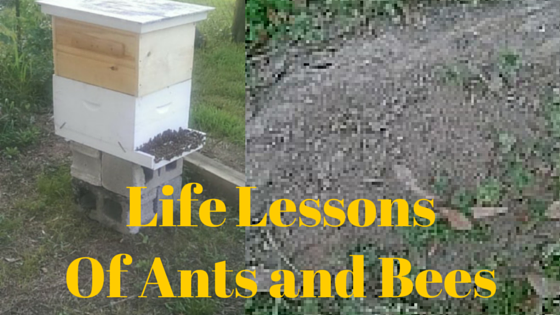
Life Lessons of Ants and Bees


Proverbs 6:6-8
6. Go to the ant, you lazy man! Observe its ways and become wise.
 7.  It has no commander, officer, or ruler,
 8.  but prepares its provisions in the summer and gathers its food in the harvest.

There are untold life lessons that are demonstrated around us daily. We could go our entire lives and never see them. In our modern world many of the lessons we should be learning are taught by creatures that in certain situations would be considered pests. Ants and bees are perfect examples.

If you have ever had the opportunity to watch ants or bees work you have to admit that they are amazing. The ant has been mentioned many times throughout history for it's industry or work ethic, no one who has ever watched ants work will deny that. What lessons can we see taught by these insects? We are going to go through a few. These are simply observations and human applications for these insects behavior.

All Ants and Bees Are Doers

There is no such thing as a lazy ant or bee. All of the members of the colony or hive are workers. Everyone has a job. There are workers, soldiers, and of course the queen. The queen isn't really a ruler though. For many species there are even different groups of workers. For ants there are foragers, gardeners, harvesters, nannies, and even more. The soldiers job is simple defense. Everyone works, everyone has a job, and everyone is important.

Be Courteous

While watching ants work you will notice that once a resource is found ants will go single file to that resource until it is exhausted. They will meet other ants coming back from the resource. Every time an ant meets another ant they stop very briefly. When they do this they are communicating. Ants lay down scent trails that communicate where resources and even where danger is, they even verify that they are members of the same colony.

The honeybee is similar but different. Scouts go out to find resources, when they come back they are greeted by the guards and workers. The guards verify that these scouts belong to this hive and the workers learn where the best pollen or nectar can be found. Communication is key to the survival of both of these insects. They are being courteous to each other because they are all on the same team and working toward a common goal, the survival of their colony. Always be courteous to other doers.

Don't Get Hung Up On One Way To Do Things

One thing about honeybees and ants as soon as something is used up they move on to something else. I know people who do everything the same way every day. There are some that are so programmed that they cannot deal with interruptions or changes of plan. I hate to say this, but there are some days that are just an adventure. It doesn't matter how much you plan, it will not work the way you want.

When I was in college, we had to read a book called Who Moved My Cheese? This is a fairly short book and really could have been shorter, but it does give an important message. Don't rely too much on the same way of doing things. I do suggest everyone read this little book, it will help you.

Prepare for the Future

Each and every member of the colony or hive is working on being prepared. They are gathering food, way more food than they need each day. They are building a deep pantry because tomorrow may storm and they will not be able to work outside. They are storing up as much as they can so their community will be able to make it through the hard times. 

Life Can Still Be Sweet

This lesson comes specifically from honeybees, but I think it applies. While you are working on providing not only your daily provision you are also laying up stores for the winter. When winter time comes you get to relax and enjoy the fruits of your labor. Nothing is better than fresh honey.

Stay True To Family

Both ants and honeybees are just one really big family. Everyone is helping everyone. Competing for things with other families but doing so for the most part peaceably. Every member is important.

Thrive Where Ever You Are

One thing I have always respected about almost all insects, especially honeybees and ants. They make the best of where ever they are. Think about it. Honeybees will make a home in a hive that we provide, a hollowed out tree, the cleft of a rock, and even if you are far enough south just a covered branch of a tree. They improvise and make the best of what is available. The same can be said of ants. I am sure you have seen an ant bed that the entry point was in the crack of a slab of concrete. I am not saying that you shouldn't strive to achieve better. What I am saying is that you should be a good steward of where you are.

Defend Your Home With Zeal

What to know what pain is? Mess with a beehive or an ant mound. Every member of the family will rise to defend their home. Honeybees give their very lives in defense of their family. I will never understand why we, as supposed superior beings have such a hard time defending our families. I am not just talking about defending our families when they are in physical danger. I am talking about a whole lot more.

I am sure you know at least one person, probably several, that talk bad about their spouse out in public. There are people who are not a good husband or wife that is true, but some of these people berate their spouse even though they love them dearly. I believe that when you have chosen a spouse you are no longer two people, you have become one. Our job is to be encouraging and supportive as much as possible. When we need to give our spouse a reality check we should do it in private. This builds respect and respect is something we all need. 


Have something to add to this topic join the Forum on The Rural Economist. If you would like to contribute to the conversation we would love to have you join us. It is brand new, but I am sure it will grow. 


Subscribe to our mailing list

* indicates required


You can like The Rural Economist on Facebook follow on The Rural Economist on Gplus. We now have a YouTube channel and we cover all sorts of things. Hop on over and check them out, oh and don't forget to subscribe. I have just joined Instagram if you would like you can follow us HERE. We will be sharing several things over the next year, I hope to see you there. 

Check out The Rural Economist on Pinterest


Affiliate Link Disclosure: This post may contain affiliate links. I may receive compensation for links, endorsements, testimonials, or recommendations for any products mentioned on this blog. Any time you use one of our links for Amazon, if you purchase something The Rural Economist receives a small commission and it doesn't cost you any more. Even if you do not purchase the items I list. In this way you will help support us trying to teach people about self reliance and homesteading. Thanks for your consideration.

Saturday, July 5, 2014

Beekeeping on a Small Homestead


Beekeeping can be very expensive to get into. Just to get started you have to buy a hive, a package of bees, a smoker, a bee suit, and then you have to decide if you are going to feed your bees. If you feed your bees you have to decide for how long. Think you are done?

Not even close. Now you have to decide if you are going to include any treatments for your new bee hive. There are treatments for varroa mites, tracheal mites, small hive beetle, foulbrood, and nosema. Don't worry, we will cover them all and their treatments as well as cost in another linked post.

Now that I have you worried about getting started with bees I am going to slowly cover as much as I can and tell you about costs and how you can reduce those costs.

The Hive

I am going to cover two types of hives, because they are the two I know most about. The Langstroth and the Top Bar aka Kenyan hive.

The Langstroth

The langstroth is what nearly everyone thinks of when you talk about a bee hive. Several rectangular boxes stacked on top of each other. There is an entrance at the bottom. For the Langstroth you will need at least one brood box. I prefer two.

Most people use a queen excluder. A queen excluder keeps the queen from going too high in the hive. This helps insures that everything above the excluder is honey and pollen, no eggs or brood.


Above the brood boxes go the supers. This is where the worker bees make and store all the honey and pollen. There are 3  types of supers; deep, medium, and shallow. A deep super filled with honey can weigh as much ad 90 pounds about 60 of which is honey. A medium as much as 60 pounds (about 40 pounds of honey) and a shallow up to 40 pounds (about 26 pounds of honey). That is a lot of honey.
Seeing 3 supers on top of 2 hive bodies or brood boxes is not uncommon.

Even though the Langstroth is the traditional hive seen all over the United States,  it is the expensive way to get into beekeeping. Unless you have a nearly complete wood workshop you cannot make a Langstroth yourself like you would buy at a beekeeping supply.

If this is the type of hive you want I strongly suggest you buy at least the first hive body, base, inner cover, telescoping top, plus the frames. I will show you how to use some "Make Do Engineering" for the rest of the boxes that you will need. But using make do engineering will actually nullify the Langstroth's primary edge over other hives. More honey production.


The reason you can get more honey from a Langstroth hive than a top bar is because of the comb foundation that is placed is the frames of the rack. These foundations mean your bees do not have to make as much wax so they are able to use their energy in wax production. Not providing this foundation effectively turns your Langstroth into a traditional looking top bar.


Without this foundation the method of extraction is the same for both. With the foundation you will want to rent, borrow, buy, or make a honey extractor.

Notice the brood chamber above does not have the wax foundation. The bees will have to work harder to build wax and fill with honey and pollen. They will actually create a more natural comb. This box will not be removed or robbed. This box will remain to provide winter food storage.

The Top Bar Hive

The top bar hive is just as expensive as the Langstroth if you buy them already made. But the top bar is a more simple design and if you are handy at all you can build a top bar complete for right around a hundred dollars.

There are several places that have plans that you can just search for. Some have far better drawings than I could provide. 

The reasons I like the top bar are several. 
1. I can make them without a complete workshop.
2. The top bar is really a more natural hive for honey bees. As a result the bees tend to be a lot more docile.
3. Less need for smoking. We will talk more about smoking bees a little later in this post.
4. A more complete harvest. If you are only into bees for the honey and you have the money to invest a Langstroth might be the style for you. If however you are wanting to be able to harvest wax as well, the top bar might be your choice.
5. I just like the looks of them better.

Equipment

This is a small list of necessary equipment that every beekeeper should have. A bee suit, smoker, hive tool, and some way of extracting the honey. The method of extraction can be as simple as good quality cheese cloth or as fancy as an extractor. We will go over each.


The bee suit. The bee suit just helps insure that you do not get stung while working the hive. I have known people and you can see videos of people on YouTube that not only work their hives without a suit, but some without a shirt. That is all well and good for them, for me I prefer to wear a suit. I am just not real keen on the thought of getting stung multiple times. I made my own suit with a pair of coveralls, pruning gloves, and a bee hood. The hood I bought you can see below the others are just like my equipment. The hood took a little while to get here because it had to be shipped from Hong Kong, but it works great. 

I use duct tape to seal any possible holes. Grand total putting together my own bee suit $49.09 and I can use the gloves and coveralls for other things. I am all about multi function. You may already have a set of long sleeve coveralls or many times you can find them at thrift stores. That will save you even more money.

Using my make do Bee suit and doing just fine.


The Smoker: A bee smoker for some reason calms the bees. They are not near as aggressive after they have been smoked. For simple manipulation of the hive many times I will not smoke at all, but when it is time to harvest honey the smoker is a necessary tool.


The Hive Tool: The hive tool is basically a small, very flat pry bar. I picked mine up locally and again multi function because guess what? I use mine as a pry bar as well. The hive tool is used to remove the inner cover, separate boxes, and remove frames. You will use this tool several times a year per hive so look at the quality and consider your own strength in the selection.


Honey extractors can be very expensive, but if you have the money to spend on them they are very nice. I have seen a 10 frame electric extractor in use. After you have uncapped the comb you just put the frames in the extractor, turn it on and honey comes out the bottom ready to strain and bottle. The one I listed above is a two frame and for my small operation would be perfect, but maybe next year. This year we have to extract the old fashioned way.


The old fashioned way is simple, but labor intensive. Cut the comb into chunks. Squeeze as much honey out into cheese cloth. The cheese cloth acts as a filter to remove any wax remnants. After you have filtered all of the easy honey, you can either feed the wax and any left over honey back to the bees or you can keep going.

Feeding back to the bees is easy. Just place near the hive and watch them work cleaning it all back up. Doing this will reduce your harvest, but it will save your bees some work. It is up to you. If you want to keep a harvest of wax as well,  you must keep going.

Place the wax inside the cheese cloth and squeeze really hard. More honey will come out and you will make a ball of what looks like pure wax, but it is not yet. Cut the ball up in several pieces and repeat. Even more honey will come out. After the second time I normally stop trying to get anymore honey.

Wax Harvest. Once you have gotten to this point you should have a couple of balls of what appear to be just beeswax. You should also have several jars of honey sitting on your counter looking absolutely delicious.

Things you will need or need to make are a double boiler and a mold. Beeswax cannot handle direct heat hence the double boiler. If you are creative you can create a "make do" one with two different size pots. The slightly larger on the bottom and the smaller on the top. I am including a link to a double boiler.

Slowly melt the wax in the double boiler either purchased or made. As the wax melts impurities will rise to the top. Just remove all the impurities with a slotted spoon, after you get all of the larger impurities out you may have to use a regular spoon for some. At this point you can choose to filter the wax. A paint strainer works great and can be obtained from anywhere automotive paint is sold. 

Now you will need a mold. You can build a mold out of wood and line it with wax paper, you can buy a mold, or you can even use the cheap travel soap dishes that you can buy at any department store. If you use the soap dishes you will want to spray it with cooking spray. Then just let the wax cool.

There you go. Probably way more than you ever cared to know about honeybees unless of course you are thinking about adding them to your homestead. I wish you all honey sweetened.

Rural Dreams and Homestead Wishes


You can subscribe to The Rural Economist by email by simply filling out the form below. Your information will never be sold or given to anyone else. 


Subscribe to our mailing list

* indicates required


You can like The Rural Economist on Facebook follow on The Rural Economist on Gplus. Or you can even follow The Rural Economist on Pintrest. We now have a YouTube channel and are doing a series on wild edible and medicinal plants. Hope on over and check them out, oh and don't forget to subscribe.

Affiliate Link Disclosure: The post contains affiliate links. I may receive compensation for links, endorsements, testimonials, or recommendations for any products mentioned on this blog.

Tuesday, June 3, 2014

The Bees' Knees:Oh Honey!


So my next adventure as a new-found ,part-time homesteader is all about those hardworking Anthrophilias,also known as the Honey Bee!

Ok, so we all know how I felt about eating fresh farm chicken eggs (Why Did the Chicken Cross the Road?Don't know,don't care.Just give me your Eggs!) How do you suppose I felt when Dear Ol' Hubby first brought up raising a hive of Honey Bees? I FREAKED! How could he stand the thought of putting us in harm's way of those pesky,angry,ready to sting anything that comes their way critters?
cartoon bee : Angry bee cartoon Illustration


Well of course he'd done this whole " Dances with Honey Bees" routine before.But that was before me.This was whole new territory. And the territory he had previously was more than a half-acre. It was actually a friend's land. He wanted us to be neighbors with the enemy.

Flash forward two years later and we now have a hive,so graciously given to us by a friend we go to church with. Let me say this; my husband did not push this one down my throat.(Ow!That would hurt!) He weighed the options, and educated me on all the benefits of having these little guys (and gals!) around.

Honey Bees are misunderstood.True to the phrase, "Busy as a bee.", these amazing insects live up to the reputation. First off Gregg told me that they will travel for miles to go after pollen.And when they return,they can communicate where the good stuff is to other worker bees! I especially loved watching YouTube videos where the bees place the pollen in little sacks on their legs.Very cool!They have guards watching over the hive,as well as the nursery having a full staff of nannies to tend to future workers and queens.

I have seen how they are diligent.I have stood near their hive and not been afraid. They really aren't concerned with me as long as I don't go poking around. I want them to learn my scent so that they become comfortable with the giant in their area.Gregg has also taught me that as long as the Queen is safe they're pretty docile.We have the Italian Honey Bees,and these are pretty laid back.

It's fascinating to watch these creatures and realize what a key role they play in our environment.Without these guys life would kinda stink. According to the National Resources Defense Council, more than $15 billion worth of crops are pollinated by bees each year in the United States alone.Whoa! These babies are the real deal. And truly, I don't wanna go without foods such as apples, almonds, blueberries, avocados, onions, grapefruit, oranges...well you get the picture.

Now for the best part.The part that Winnie the Pooh dreams of.Yes, the liquid gold of nature. I can't wait til our girls start putting out the Honey!And the beeswax too. I have much to learn about the many uses of it.
Back to the honey. According to people who harvest it, it's not just good for eating. It's also supposedly good for seasonal allergies.The Mayo Clinic is not completely agreeing with that,however they're not disregarding  it either.You can check it out yourself at www.mayoclinic.org/diseases/honey-for-allergies. They do say that the idea isn't far-fetched since honey is used as a cough suppressant and could act as an anti-inflammatory. They also point out that honey contains flower pollen which is commonly used against allergens. I'm no expert, but I'm willing to give it a try. And ladies there are recipes you can find online that are great for the skin. A friend of mine made one,It was awesome!

Another thing to consider is what type of box you want. There are three common types.The Langstroth, the Warre, and the Top Bar. We are as of right now using the former due to the fact when we got the bees they were already placed in it and Gregg didn't want to disturb them. With the Langstroth, you will get more honey with it than a top bar, but less beeswax. Some experts claim the Top Bar is more like their natural habitat which keeps the bees calmer. It really depends on your preference. Next year we will probably try out the Top Bar since we have it.


It's still awhile off until we get our first batch of honey and for all of you newbies out there like me who were cynical and scared, just know that I'm sold out on Honey Bees and I have a new found respect for them and their place in this world. I plan to do a follow up on the harvesting of our first batch of honey. Wish me luck!

Embracing the many adventures of Homesteading.
The Un-Country Country Wife.