Showing posts with label faith. Show all posts

Wednesday, June 3, 2015

One Day in Seven to Rest: Wednesday Devotion


Genesis 2: 1 - 3

1 Thus the heavens and the earth were finished, and all the host of them. 

2 And on the seventh day God finished his work that he had done, and he rested on the seventh day from all his work that he had done. 

3 So God blessed the seventh day and made it holy, because on it God rested from all his work that he had done in creation.

The thoughts and rules about observing a day of rest vary from one extreme to another. There are some who believe that on a rest day, nothing should be done, no cooking, no cleaning, no outside activities. Others see a day of rest as an opportunity for enjoyable activities and adventure. Like so many things I believe the truth lies somewhere in the middle.

Why Did God Rest?


It isn't very difficult to imagine that God might need to rest. We get tired and after all we are made in His image. I however do not think that God was exhausted from creation. I believe that He took a day of rest as an example to humanity. If we look at the totality of scripture we see that God never sleeps. 

Psalms 121: 3

3 He will not let you stumble; the one who watches over you will not slumber.

Most of the rituals for gods involved making a lot of noise. Why would this be the case? Well, what if your god was asleep? 


Rules for a Day of Rest


In the beginning the only rule was to rest every seventh day. Like so many things the rule was strengthened over time. At first there were just a few simple rules. As time progressed the rules were strengthened, because that is what rules do. I would like to point out that few of the orthodox Jewish rules for the Sabbath actually appear in the Bible.

According to Jewish tradition there are 39 categories of activities that are prohibited on the Sabbath day. These categories are then further defined.

Planting, plowing, reaping, gathering, threshing, winnowing, sorting/purification, grinding, sifting, kneading, cooking/baking, shearing, carding/combing wool, dyeing, spinning, weaving (including multiple steps), sewing, tying, untying, tearing, trapping, slaughtering, skinning, Smoothing, writing, erasing, cutting, building, construction, demolition, well you get the picture. 

Most of these prohibitions were by interpretation, eventually these restrictions even included how many steps a person could take in a day. When a person was found guilty of breaking any of these prohibitions the punishment was death. Pretty strict don't you think? There were exceptions to the laws. If a fire broke out and it was going to damage property, by law you had to let it burn. But if a person's life were in danger everyone was required to try to put out the blaze. A person's life was more important than the law.

What had started out as a day of rest had turned into a very strict ritual. When Jesus came along there had been thousands of years of adding restrictions. Jesus and his disciples were not very legalistic when it came to the Sabbath. Jesus regularly healed people on the Sabbath, an activity that made the religious leaders hate Him.

Mark 2: 27 NLT

Then Jesus said to them, “The Sabbath was made to meet the needs of people, and not people to meet the requirements of the Sabbath.

That statement was very powerful. God instituted a day of rest for the benefit of mankind, not for an observation of ritual. God knew that our bodies and minds require time to rest for us to be healthy. That was what God intended. God knew that for many of us to really rest, we need to have a full day and we need encouragement to do so. I am the worst at resting. If I think of something that needs to be done, I am going to get up and do it. 

Saturday or Sunday


All of Jewish tradition the day of rest was a Saturday, or to be more correct from Friday night through Saturday at nightfall. A full 24 hours. 

I am not going to get into a theological debate with anyone. Each has their own reasons for how they believe and how they worship. The early Christians kept the Sabbath and went to the synagogue, then on Sunday they had their "Jesus" meetings. The reason the Christian services were on Sunday is because the Bible says that Jesus rose from the dead on the first day of the week. Sunday became known as the Lord's day. Revelation 1: 10 actually refers to Sunday as the Lord's day.
During the time of Paul the apostle there were Jewish converts that were trying to get Gentile Christians to follow the law. This was a constant battle for Paul and the first Christians.

Romans 3: 28

For we maintain that a person is justified by faith apart from the actions prescribed by the Law.
Constantine the first Roman emperor to convert to Christianity passed a law that required Christians to worship on Sunday. There are still many that believe the Sabbath is the correct day on which to worship, but thankfully since we are no longer under the law, we don't have the restrictions.
Worship can take many forms. I love my church and I really enjoy good sound doctrinal teaching, but there is something to be said for time in nature. Everything around us proclaims the glory of God. Don't get caught up in legalism. Pray, spend time in God's word and allow Him to guide you.
Take time to rest. Take time to enjoy God's creation... after all He made this world for our enjoyment.

Bringing Rural Back

Have something to add to this topic join the Forum on The Rural Economist. If you would like to contribute to the conversation we would love to have you join us. It is brand new, but I am sure it will grow. 


Subscribe to our mailing list

* indicates required


You can like The Rural Economist on Facebook follow on The Rural Economist on Gplus. We now have a YouTube channel and we cover all sorts of things. Hop on over and check them out, oh and don't forget to subscribe. I have just joined Instagram if you would like you can follow us HERE. We will be sharing several things over the next year, I hope to see you there. 

Check out The Rural Economist on Pinterest
Visit The Rural Economist's profile on Pinterest.

Affiliate Link Disclosure: This post may contain affiliate links. I may receive compensation for links, endorsements, testimonials, or recommendations for any products mentioned on this blog. If you see something you are interested in, check them out. Thanks for your consideration.

Thursday, May 28, 2015

Don't Mess with Our Pigs: Wednesday Devotion


Luke 8: 26 - 40 NHEB

 26  They arrived at the country of the Gerasenes. which is opposite Galilee.

 27  When Jesus stepped ashore, a certain man out of the city who had demons for a long time met him. He wore no clothes, and did not live in a house, but in the tombs.

 28  When he saw Jesus, he shouted, and fell down before him, and with a loud voice said, “What do I have to do with you, Jesus, you Son of the Most High God? I beg you, do not torment me!”

 29  For Jesus was commanding the unclean spirit to come out of the man. For the unclean spirit had often seized the man. He was kept under guard, and bound with chains and fetters. Breaking the bands apart, he was driven by the demon into the desert.

 30  Jesus asked him, “What is your name?” He said, “Legion,” for many demons had entered into him.

 31  They begged him that he would not command them to go into the abyss. 

 32  Now there was there a herd of many pigs feeding on the mountain, and they begged him that he would allow them to enter into those. He allowed them.

 33  The demons came out from the man, and entered into the pigs, and the herd rushed down the steep bank into the lake, and were drowned.

 34  When those who fed them saw what had happened, they fled, and told it in the city and in the country.

 35  Then people went out to see what had happened. They came to Jesus, and found the man from whom the demons had gone out, sitting at Jesus’ feet, clothed and in his right mind; and they were afraid.

 36  Those who saw it told them how he who had been possessed by demons was healed.

 37  All the people of the surrounding country of the Geresenes asked him to depart from them, for they were very much afraid. He entered into the boat, and returned.


 38  But the man from whom the demons had gone out begged him that he might go with him, but Jesus sent him away, saying,
 39  “Return to your house, and declare what great things God has done for you.” He went his way, proclaiming throughout the whole city what great things Jesus had done for him.

I love this story for a lot of reasons.

First, this was a Gentile city with a heavy Greco/Roman population and Jesus went there on purpose. This in my opinion proves that Jesus didn't limit himself to the Jewish people even during His earthly ministry.
Second, demons knew who Jesus was and knew He had power to command them. Not only that, demons can experience fear. They begged not to be cast into the abyss. The fact that demons begged shows that they fear the abyss. There are entirely articles and even books written about the abyss, so we won't go there for now. Just the realization that demons experience fear is enough.

Third, this shows the absolute power and authority Jesus had as a person on this earth. Just the knowledge that he was able to cast that many demons out is mind boggling.  But this story brings up some questions as well.

Why was the demon's name Legion?

When the demon began begging Jesus not to send them to the abyss, Jesus asked its name. The response was "my name is Legion for we are many" Mark 5:9. A Roman legion normally consisted of up to 6,000 soldiers. Why do I bring this up? Well if there were say only 5 demons in the man then logically only 5 pigs would have committed suicide. Again according to Mark 5:13 over 2000 pigs ran into the sea. There could have been multiple demons in a pig, but I think it is safe to say that around 2000 demons were in this man.

Why did Jesus allow the demons to enter the pigs?

This is a question I have thought about often. Was Jesus showing mercy on the demons? What happened to the swine herder? Why did the people ask Him to leave? Why did Jesus make the man stay and not allow him to become a disciple? We will take each one of these questions.


Was Jesus showing mercy on the demons? 

I actually thought this at first, but then I thought why would he do that? At first I thought Jesus was just that compassionate, but as I kept reading I realized that there were several times that the Bible said Jesus was moved with compassion. This was not one of those times. I think Jesus saw an opportunity to impact an entire city and not just this man and his family. I know this sounds bad, but delivering a man from his bondage would not have had as immediate an impact as the pigs did. The pigs effected the entire city. These were Gentile people and we love our bacon. Having that many pigs die at once was a big deal. That in conjunction with the man now being able to function was huge.

What happened to the swine herder? 

I wish I could give you an answer, but I really can't. I do know that everyone who was keeping the pigs witnessed what happened and told the residents of the city what had occurred. For a short period of time, I am sure they were local celebrities.

Why did the towns people ask Jesus to leave? 

The most obvious reason is fear, but why would these people be more afraid of Jesus than a demon possessed man? I think there are a couple of reasons the towns people feared Jesus more than the demon possessed man.
  1. They had gotten used to him. Yes he terrorized people and he was naked and he couldn't be confined, but "That is just crazy ol' Joe." If this were today this man might have even been a tourist attraction. I can imagine people coming from miles around just to see Ol' Joe. They would have had to bought something to eat and maybe even spend the night.
  2. This was different. When they didn't want to deal with Ol' Joe they would bind him with chains. This would keep him for a little while, but he would break the chains and run off. Now however; he was sitting at the feet of a man, fully clothed, and carrying a normal conversation. This would be enough to make anyone question the power involved.
  3. This event cost the town dearly. This herd of pigs could have been the entire supply of pork for that city. The truth is we don't know. What we do know is this freaked out the community. Don't Mess With Our Pigs!

Why did Jesus not let the man follow Him? 

I really wish we knew this guys name. This man was the first evangelist. His job was simple tell your story. That is all, no more. Apparently he told it well. He told everyone who would listen and even talked at people who didn't want to listen. Not only did the man that was freed talk, you know the swine herders talked about it a lot as well.

 40  When Jesus returned, the crowd welcomed him, for they were all waiting for him.

Here is where the story of an entire town turning Jesus away because He messed with their bacon becomes a story of victory. We really don't know how long it was between these two trips, but we do know it was long enough for the word to spread. The second time Jesus came to town not only was He welcomed, the town was waiting for Him to return.

Conclusion

We don't see demon possession in modern times, or do we? I believe that demon possession is still alive and well in today's world. I do think most of the time it takes on a different look. The devil is smart, anyone who says he isn't has not been paying attention. I believe the devil adjust his strategy based on the situation. In a time when everyone was religious, fear was a great attractor of attention. In a time when people are more secular and selfish a more subtle approach is better.

I am sure this town was grateful to have the demon possessed man freed. No more worrying if he would attack a merchant on the road, no more interruptions during festivals,  there would be many reasons to be thankful that this man was freed from this bondage. But, before the full knowledge of what had truly occurred in the life of this man and in the life of the town, there was the immediate loss of their ham, bacon, and chops. No matter who we are we have things that we would like to be freed from. But just like this town there are things that we would rather not do without.

We do not have to follow strict dietary guidelines in order to become a Christian. There are a lot of things that people claim are a part of the Christian life that really aren't. There are many rules that have been made since the time of Christ. These rules may have started out with a good reason, but in time they become ritual more than worship or practice rather than praise.

I am a firm believer that when a person becomes a Christian they do not have to do anything on their own. The things that God wants them to give up, He will work on the person from the inside out and they will want to give those things up as well. Don't focus on legalism of religion. Focus on the freedom of Jesus.

I hope you enjoy these Wednesday Devotions.

Bringing Rural Back

Have something to add to this topic join the Forum on The Rural Economist. If you would like to contribute to the conversation we would love to have you join us. It is brand new, but I am sure it will grow. 


Subscribe to our mailing list

* indicates required


You can like The Rural Economist on Facebook follow on The Rural Economist on Gplus. We now have a YouTube channel and we cover all sorts of things. Hop on over and check them out, oh and don't forget to subscribe. I have just joined Instagram if you would like you can follow us HERE. We will be sharing several things over the next year, I hope to see you there. 

Check out The Rural Economist on Pinterest
Visit The Rural Economist's profile on Pinterest.

Affiliate Link Disclosure: This post may contain affiliate links. I may receive compensation for links, endorsements, testimonials, or recommendations for any products mentioned on this blog. If you see something you are interested in, check them out. Thanks for your consideration.

Wednesday, May 20, 2015

On Following Christ and Plowing

Puts a hand to the Plow
Original art from the Gutenberg Project
http://www.gutenberg.org/files/23353/23353-h/23353-h.htm


Luke 9: 57 - 62 NIV

57 As they were walking along the road, a man said to him, “I will follow you wherever you go.”

58 Jesus replied, “Foxes have dens and birds have nests, but the Son of Man has no place to lay his head.”

59 He said to another man, “Follow me.”

But he replied, “Lord, first let me go and bury my father.”

60 Jesus said to him, “Let the dead bury their own dead, but you go and proclaim the kingdom of God.”

61 Still another said, “I will follow you, Lord; but first let me go back and say goodbye to my family.”

62 Jesus replied, “No one who puts a hand to the plow and looks back is fit for service in the kingdom of God.”

There is a massive difference between reading something and reading something with the intention of teaching or explaining. I have read this many times before, but it wasn't until I started working on this post that I realized how harsh these responses sounded. After digging a little deeper, I think I understand.

This scripture has been on my list for the Wednesday Devotion ever since I made the decision to start this series. There is a lot here to cover.

At the time of this scripture Jesus is pretty much at the height of his earthly ministry. I figure there were lots of people who were following Him around, but there was a difference in following and being a follower. Where ever Jesus was exciting things happened. People were healed, demons were cast out of people, multitudes of people were fed by a child's sack lunch. Wherever Jesus was, was the place to be. But being a part of the inner circle, that was different.

The end of Jesus's earthly ministry was drawing near and before someone was accepted as a disciple, Jesus wanted them to understand the cost.

No Home


Jesus had a traveling ministry. He and his disciples slept under the stars as often if not more often than they slept in someone's home. Even then it was someone who invited them to stay. I believe these opportunities decreased a great deal after the four friends tore the roof off of a house to be able to get their paralysed friend before Him. Warning this man that they had no home was fair and honest.

Let the Dead Bury Their Dead


This one I found a little difficult to understand for a while. According to Jewish tradition, when a family member died, someone has to stay with the body. All of the immediate family are required by tradition to be mourners. This young man really should have been with his family. If this young man was willing to avoid his traditional responsibility to his family, how would he react in the face of persecution.

Let Me First Say Goodbye


This one I understood easily.  This man wanted to follow Jesus, but he wanted to tell his folks goodbye, that seems normal enough, but I believe that there is a lot more to it. Can you imagine what the scene would have been like around Jesus on a daily basis? To be counted among His true followers probably came with a level of notoriety. The religious leaders would hate you, but the common people would say "He is a follower of Jesus" and say it with a level of respect and possible awe. People can be easily swayed by emotion. I know some who have declared faith in Christ because their friends did so or because their parents wanted them to, or even because the preacher gave an emotional message that moved them. The decision to become a Christian is not one to be made lightly. Conviction should be the motivator not emotion. These two are easily confused. Conviction can come and go, but it is an insistent knowledge of being imperfect. It can be a regular remembrance of a specific event or a general sense of missing the mark. After all that is what sin is.

Sin is an archery term.  To sin is to miss the bulls-eye, while still hitting the target. Anything short of perfection is sin and sin is a word we do not like to use.


The Plowing Analogy

I love this analogy. It is a perfect word picture of a Christians life. If you have ever plowed a field with mules, horses, oxen, or a tractor even for that matter, this statement is easy to understand. When I first started learning to plow using draft animals, I was lucky enough to find an ol' timer to help me out. His first bit of advice what "Don't look at what you are doing. Find a landmark off in the distance, focus on that, drive toward that mark." When I followed that advice I had nice straight furrows. As soon as I looked at the plow cutting through the ground, my furrow would be a little off. A couple of times I looked back to admire my work. As soon as I did, I had a major curve in my furrow. 

An old photo of Abbie and myself taking a little break.
We as Christians are a lot like my plowing job. As long as we keep our eyes on Jesus we are able to stay straight. As soon as we take our eyes of Jesus and start looking at what we are doing problems begin. If we start looking back it is real easy to get sideways. 

There are always things in our past that can take our eyes off of Jesus. Many times we as people want to revel in our victories,  brag about our scars, cry over our heartaches, and complain over the ways we have been mistreated. This is true in so many ways and it is something that I still struggle with.

Looking back not only affects our relationship with God, it can also hinder our relationship with others. My wife is the most wonderful woman in the world. Don't believe me? Just ask me and I will tell you again. We have both been through some really bad relationships in the past. From time to time however we will both revert back to the reactions we had in our previous relationships, I more often than her. It is not fair to my wife for me to look at her through the lens created by someone else. When we both focus on Jesus and each other, in that order things work so much better.

I hope you are enjoying the Wednesday Devotions.

Bringing Rural Back

Have something to add to this topic join the Forum on The Rural Economist. If you would like to contribute to the conversation we would love to have you join us. It is brand new, but I am sure it will grow. 


Subscribe to our mailing list

* indicates required


You can like The Rural Economist on Facebook follow on The Rural Economist on Gplus. We now have a YouTube channel and we cover all sorts of things. Hop on over and check them out, oh and don't forget to subscribe. I have just joined Instagram if you would like you can follow us HERE. We will be sharing several things over the next year, I hope to see you there. 

Check out The Rural Economist on Pinterest
Visit The Rural Economist's profile on Pinterest.

Affiliate Link Disclosure: This post may contain affiliate links. I may receive compensation for links, endorsements, testimonials, or recommendations for any products mentioned on this blog. If you see something you are interested in, check them out. Thanks for your consideration.

Wednesday, May 13, 2015

It all Started in a Garden: Wednesday Devotion


Genesis 2:8-9, 15-17 NLT

8 Then the LORD God planted a garden in Eden in the east, and there he placed the man he had made. 9 The LORD God made all sorts of trees grow up from the ground—trees that were beautiful and that produced delicious fruit. In the middle of the garden he placed the tree of life and the tree of the knowledge of good and evil.

15 The LORD God placed the man in the Garden of Eden to tend and watch over it. 16 But the LORD God warned him, “You may freely eat the fruit of every tree in the garden— 17 except the tree of the knowledge of good and evil. If you eat its fruit, you are sure to die.”

Adam the Gardener


There is so much here. First God told man to tend and keep the garden. It was man's first job to be a gardener. Oh but there is more, so much more.

God placed man in the garden before He created woman. Adam was surrounded by so much beauty but something was still missing. God brought all of the animals before Adam to see what he would name them. I am sure this took a while. Then God created woman.

I have tried to imagine what life would have been like in the Garden. Sleeping when we get tired. Waking when we were refreshed. Selecting anything we wanted to eat and then planting the seeds of what we had just eaten. The beauty would have been unspeakable.

Paradise and a Soul Mate Too


Genesis 2:21-23 NASV

21 So the Lord God caused a deep sleep to fall upon the man, and he slept; then He took one of his ribs and closed up the flesh at that place. 22 The Lord God fashioned into a woman the rib which He had taken from the man, and brought her to the man. 23 The man said,
“This is now bone of my bones,
And flesh of my flesh;
She shall be called Woman,
Because she was taken out of Man.”
24 For this reason a man shall leave his father and his mother, and be joined to his wife; and they shall become one flesh.

Now imagine the most beautiful place you have ever seen and multiply that by, oh I don't know, say 1000. For us today the beauty would have been breathtaking. Now think about being in a place like that with your true soul mate. 

This was the very first family. Adam and Eve only had three commands: 1) Be fruitful and multiply 2) Take care of the garden and 3) Don't eat from one tree, the tree of Knowledge of Good and Evil.
I want to pause here for just one moment. Man and woman's first command was to be fruitful and multiply, with this in mind where did God place them? Yup, he placed them in a garden, not in the mountains, not by the sea, He didn't even create them a village to help them get a jump start. He placed them in a garden. Why do you think He did this. I think we find at least part of the reason here.

God Loves a Garden


Genesis 3:8 NASV

8 They heard the sound of the Lord God walking in the garden in the cool of the day, and the man and his wife hid themselves from the presence of the Lord God among the trees of the garden.

God created man for friendship, not servitude. God placed man in a garden because God loves a garden. This scripture occurs after man has sinned by eating of the only forbidden plant in the entire garden.
I believe God walked through the garden in the cool of the day fairly often. I don't think man and woman were surprised that God was walking in the garden. Cool of the day has also been translated "breezy time of the evening".

I must be fair at this point and state that some commentaries say that God was not out for an evening stroll, but was coming in judgment. However many of those same commentaries point out that Adam and Eve hid not because they were afraid but because they were naked.

Again I want to point out that man and woman only had three commands and they have already broken one of those. I don't know how long they were in the garden together communing with God and each other, but I hope it was a good long time. I hope it was, but I doubt it. 


The Blame Game


Genesis 3: 8 - 13 NIV

8 Then the man and his wife heard the sound of the Lord God as he was walking in the garden in the cool of the day, and they hid from the Lord God among the trees of the garden. 9 But the Lord God called to the man, “Where are you?”

10 He answered, “I heard you in the garden, and I was afraid because I was naked; so I hid.”

11 And he said, “Who told you that you were naked? Have you eaten from the tree that I commanded you not to eat from?”

12 The man said, “The woman you put here with me—she gave me some fruit from the tree, and I ate it.”

13 Then the Lord God said to the woman, “What is this you have done?”

The woman said, “The serpent deceived me, and I ate.”

Does this exchange really sound like God was coming in a storm of vengeful judgement? Not to me. This sounds more like a caring parent or a close friend showing concern. 

God started calling "Where are you?". To me this means that God and man probably had regular walks through the garden. God already knew what was done, He didn't have to be told, but I believe He was giving Adam and Eve an opportunity to come clean, who knows maybe the curse wouldn't have been so bad. We will never know.

vs 10 I hid because I was naked. I find this very interesting. They had always been naked, in fact before God we are still all naked. They hid because they were ashamed and we as a people have been hiding from God ever since.

Now, I am probably going to offend a few folks. I don't mean to, but this is the way I see this scripture. God went to Adam first. He asked "Have you eaten from the tree that I commanded you not to eat from?". Oh, if he had only had a backbone and said yes. He did eat from the tree that God had forbidden. He knew the fruit was from that tree. Eve did not force feed him. He wasn't even deceived. Adam committed open rebellion. He made a conscience decision to disobey God. 

How did Adam respond? He blamed his wife. I know this isn't popular anymore. I also know that the reason this isn't popular is because so many men wouldn't take the job, but the man was supposed to be the spiritual leader of the household. Women had to take over because too many men were just too lazy or too unconcerned to do their job. 

I can hear it now there are some guys and gals that are screaming "Preach on Brother!" and there are some of both that probably just decided they would never read another word I write. The thing is man was supposed to be the leader, not the master. Guys, if you have your soul mate, you have the most priceless gift that could ever be experienced on this earth. Ladies, if you have a man that treats you like you are supposed to be treated you will never feel dominated. Adam should have taken responsibility for his own actions, instead he passed the buck on to his wife. 

Eve told the truth, kinda. The serpent did put the thought in her mind or at least give the thought words. 

Genesis 3: 2 - 3 NIV

2 The woman said to the serpent, “We may eat fruit from the trees in the garden,3 but God did say, ‘You must not eat fruit from the tree that is in the middle of the garden, and you must not touch it, or you will die.’”

I have read this story over and over and I cannot find where God said not to touch the tree of knowledge. Why did she add that to her response? 

Genesis 3: 6 

6 When the woman saw that the fruit of the tree was good for food and pleasing to the eye, and also desirable for gaining wisdom, she took some and ate it. She also gave some to her husband, who was with her, and he ate it.

See, Adam was with her the whole time. Why didn't Adam step in? Why didn't he run the serpent off? Why didn't he do anything? All of the beauty, all of the perfection, all of the peace, everything was thrown away to learn that we were naked. 

Ever since the fall of man we have tried to recreate the beauty of the Garden of Eden. There have been some beautiful gardens, but nothing will ever come close. From this point on we will find that the garden can truly be a spiritual place, in fact Jesus went to a garden himself to pray. There are many lessons to be learned from the soil and from nature.

I hope you are enjoying the Wednesday Devotions.

Bringing Rural Back

Have something to add to this topic join the Forum on The Rural Economist. If you would like to contribute to the conversation we would love to have you join us. It is brand new, but I am sure it will grow. 


Subscribe to our mailing list

* indicates required


You can like The Rural Economist on Facebook follow on The Rural Economist on Gplus. We now have a YouTube channel and we cover all sorts of things. Hop on over and check them out, oh and don't forget to subscribe. I have just joined Instagram if you would like you can follow us HERE. We will be sharing several things over the next year, I hope to see you there. 

Check out The Rural Economist on Pinterest

Thursday, May 7, 2015

Principle vs Fashion: Wednesday Devotion


Principle vs Fashion


Luke 6: 48-49 (KJV)

48  He is like a man which built an house, and digged deep, and laid the foundation on a rock: and when the flood arose, the stream beat vehemently upon that house, and could not shake it: for it was founded upon a rock.

 49  But he that heareth, and doeth not, is like a man that without a foundation built an house upon the earth; against which the stream did beat vehemently, and immediately it fell; and the ruin of that house was great.

I have heard this scripture preached on dozens of times. Every time the emphasis has been on doctrine and why not that is the way Jesus explained it as well. I however believe that this passage applies to more. We are going to take some time to examine just how deep these two verses can be.

What is doctrine?


Doctrine is defined as a belief or set of beliefs held and taught by a church, political party, or other group
You can see from this definition that a doctrine can be anything taught by more than one person. By this definition not only does every religion have a doctrine, but every family does as well. Their doctrine are the beliefs that shape the way they interact with each other, their environment and the world. It is the foundation upon which they build themselves as an individual and as a group.

What is a foundation?

The word foundation has been used for a few different things.
(1) the lowest load-bearing part of a building or structure typically underground
(2) the underlying principles upon which a belief is founded

There are other meaning used for foundation now, but these are the two we are concerned with in this post. In this short parable Jesus refers to a buildings foundation as a descriptive of His teachings.

The best foundation is bedrock. If you have ever gotten stuck in the mud in a vehicle you know that dirt or soil will sink and even squish out from under an object. When building a structure you really do not want to just build it on top of the soil. That could be okay if you were building a temporary structure, but for a permanent dwelling a foundation is required.

When a person builds a structure on the ground without a foundation settling will occur. Settling is when the dirt under the load bearing portions of the structure compact. This might be acceptable if all of the ground settled the same amount, but it never does. Some parts will sink more than others. I am sure you have seen commercials for foundation repair services. If these structures had been built on a firm foundation, these repairs would be unnecessary.

The problem is that we as a people are always looking for shortcuts. All of the modern day foundations or footers are man made. Modern foundations are made of concrete and rebar. If these foundations are too thin  the foundations will crack and settling will occur.

Sometimes we build our lives on principles that are thin. Building our lives on what society considers fashionable is a very thin foundation. Fashion is always changing, if a person based their lives on societal norms, their basic beliefs will always be changing. I understand that sometimes core beliefs can change but those changes should happen as a result of deep thought or sometimes even an epiphany.

What are good principles?


God first, family second, hard work, and what you do will come back to you.

God first. I know this is very unpopular. I know that a lot of people look at the Bible as a book of don'ts. There are a lot of don't dos in the book, but there are a lot more dos in the Bible than people realize.

Family second. There are a lot of people who will abandon you when time gets tough. If you have a close knit family they will stand by your side. Family will walk through blazes and grin on the journey.

Hard work does not necessarily mean for a corporate entity. Hard work is a continual diligent improvement of your own situation. This diligence can be on a job, in your garden, in a relationship, anything that is of value to you.

Karma, or at least that is what most people call it today is based on a spiritual principle. Everything we do will bring a harvest. When we do good things, good things will come back to us. When we do bad things, bad things will come back to us.  It is the sowing and reaping thing again. Simple and logical.

Having deep held principles can and should guide should guide our actions and reactions. The Bible has been under attack, but the scriptures still hold the best guide for everyday life. If we apply those truths our world would be a better place.

Life Based on Fashion


A life that is founded on what is currently socially acceptable or fashionable tends to be materialistic, self centered, and indulgent. Decisions are based on immediate gratification. We live in a drive thru wold. Fashion is selfish and ever changing.

There are people who call themselves Christians who don't have strong held principles and there are folks who have never been to a church that are solidly grounded in what they believe. 

When hard times come, and believe me they will, having a foundation of time honored principles will see you through. Build your life on a firm foundation, the rock of principles, not the shifting sands of fashion.

I hope you are finding these devotions beneficial. 

Bringing Rural Back


Have something to add to this topic join the Forum on The Rural Economist. If you would like to contribute to the conversation we would love to have you join us. It is brand new, but I am sure it will grow. 


Subscribe to our mailing list

* indicates required


You can like The Rural Economist on Facebook follow on The Rural Economist on Gplus. We now have a YouTube channel and we cover all sorts of things. Hop on over and check them out, oh and don't forget to subscribe. I have just joined Instagram if you would like you can follow us HERE. We will be sharing several things over the next year, I hope to see you there. 

Check out The Rural Economist on Pinterest
Visit The Rural Economist's profile on Pinterest.


Wednesday, April 29, 2015

Man Was Created from the Soil


Genesis 1:26-30 King James Version (KJV)

26 And God said, Let us make man in our image, after our likeness: and let them have dominion over the fish of the sea, and over the fowl of the air, and over the cattle, and over all the earth, and over every creeping thing that creepeth upon the earth.

27 So God created man in his own image, in the image of God created he him; male and female created he them.

28 And God blessed them, and God said unto them, Be fruitful, and multiply, and replenish the earth, and subdue it: and have dominion over the fish of the sea, and over the fowl of the air, and over every living thing that moveth upon the earth.

29 And God said, Behold, I have given you every herb bearing seed, which is upon the face of all the earth, and every tree, in the which is the fruit of a tree yielding seed; to you it shall be for meat.

30 And to every beast of the earth, and to every fowl of the air, and to every thing that creepeth upon the earth, wherein there is life, I have given every green herb for meat: and it was so.

Genesis 2:7 New King James Version (NKJV)

7 And the Lord God formed man of the dust of the ground, and breathed into his nostrils the breath of life; and man became a living being.
Every other creature was spoken into existence. Man and woman were actually formed by the hand of God out of the soil of the ground. No mater what your beliefs are, you cannot deny that after our body dies and decays it becomes soil again.

Mankind was God's special creation. We were created to commune with God. God doesn't need us, but he wants us to be his friends and family. I am sure you know what I mean. There are a lot of things that we want but really do not need.

Everything that man needs to survive and to thrive physically is provided by the earth, God's creation. God gave mankind dominion over all the earth. Dominion, not to abuse or rape the earth, but to be a good steward of the bounty the earth can provide. Since the very beginning seed time and harvest were initiated and they shall remain as long as this earth continues.

I believe one of our biggest problems in society today is we are living in a fabricated world. The world we live in would have been a wild fantasy a hundred years ago. There have been barbaric times throughout history, but in all honesty we live in barbaric times now, oh we think we have culture because of all of the stuff we have around us. Think about it the reasons a person is murdered today are the same reasons a person was murdered a thousand years ago, possessions, emotions, and power. 

When a person first truly looks at the soil they are truly amazed. In a single handful of healthy soil there are millions of tiny living creatures. Some of these creatures you can see many you can't. Most of the life in that handful of dirt is so small that only a microscope can bring them into focus. 

The farther we get away from the soil the more difficult it is for us to connect with God. The soil, the garden, in fact all of nature proclaims to me there is a God and he loves us. I know there are scientific reasons for a lot of things that I think are glorious, but a rose does not have to be beautiful to get insects to pollinate them, they do not have to smell so good. I believe the earth was created for our pleasure and for us to experience God.

I have had people ask me why I want to know about all of the edible and medicinal plants that grow wild. To many people that is so strange when there is a grocery store only a few miles away. Verse 29 holds the answer.

29 And God said, Behold, I have given you every herb bearing seed, which is upon the face of all the earth, and every tree, in the which is the fruit of a tree yielding seed; to you it shall be for meat.

I firmly believe that in plants there is a cure for every disease that we will ever come in contact with. I do not believe that God created this earth just for existence and for beauty. I believe he created this place because he knew we would fall, he knew all of the things we would face and he built in the answers to every challenge. I find the fingerprint of God in nature quite often, if you look close you might too.

Man was created from the soil, sustained by the soil, and our body will return to the soil, all for the glory of God.

Together we are Bringing Rural Back

Have something to add to this topic join the Forum on The Rural Economist. If you would like to contribute to the conversation we would love to have you join us. It is brand new, but I am sure it will grow. 


Subscribe to our mailing list

* indicates required


You can like The Rural Economist on Facebook follow on The Rural Economist on Gplus. We now have a YouTube channel and we cover all sorts of things. Hop on over and check them out, oh and don't forget to subscribe. I have just joined Instagram if you would like you can follow us HERE. We will be sharing several things over the next year, I hope to see you there. 

Check out The Rural Economist on Pinterest

Tuesday, April 21, 2015

Faith on the Homestead


Faith is a necessary part of our lives. I have found that most people are searching for meaning. I believe that the scriptures are a guide for our lives. Many times people and even congregations will let us down, but the Word of God will never let us down. 

I have decided that we are going to add a devotion to our blog. I have no idea how often these posts will be made.  Most if not all of the posts will fall under a category I will call "Spiritual Lessons From The Garden". I will be as diligent as possible and promise to do my research well. 

As I have studied the scriptures I have always found it interesting that most of Jesus's parables had to do with the farm life. I have heard several preachers and theologians say that he used farm and garden stories because that is what the people understood. While I agree there is some truth to that evaluation, I believe it goes much deeper. I believe that lessons from the garden are directly related to spiritual lessons.

Looking at history I can see that during this period of time there were several trades that were active. There were blacksmiths, carpenters, traders, physicians, and even scholars. There were plenty of trades that could have  been offered as examples, but Jesus chose rural life as his way of explaining heavenly principles.

The Parable of the Sower

Matthew 13: 3-9

3  Then he began to tell them many things in parables. He said, “Listen! A farmer went out to sow. 4  As he was sowing, some seeds fell along the path, and birds came and ate them up.
5  Other seeds fell on stony ground, where they did not have a lot of soil. They sprouted at once because the soil wasn’t deep.
6  But when the sun came up, they were scorched. Since they did not have any roots, they dried up.
7  Other seeds fell among thorn bushes, and the thorn bushes grew higher and choked them out. 8  But other seeds fell on good soil and produced a crop, some 100, some 60, and some 30 times what was sown.
9  Let the person who has ears listen!”

Here is Jesus's explanation of this parable to the disciples.

Matthew 13: 18-23

18  “Listen, then, to the parable about the farmer.
19  When anyone hears the word about the kingdom yet doesn’t understand it, the evil one comes and snatches away what was sown in his heart. This is what was sown along the path.
20  As for what was sown on the stony ground, this is the person who hears the word and accepts it joyfully at once,
21  but since he doesn’t have any root in himself, he lasts for only a short time. When trouble or persecution comes along because of the word, he immediately falls away.
22  As for what was sown among the thorn bushes, this is the person who hears the word, but the worries of life and the deceitful pleasures of wealth choke the word so that it can’t produce a crop.
23  But as for what was sown on good soil, this is the person who hears the word, understands it, and produces a crop that yields 100, 60, or 30 times what was sown.”

Let us bring this to today. I am not foolish or arrogant enough to think that I know better than Christ, but I believe that a bit of elaboration will help.

Every action we take and every word we say are seeds. Every person we come in contact with is our field. On a daily basis we have the opportunity to sow seeds of faith or seeds of contention.
We are the ambassadors of Jesus. Even when we are not so lovely. Every seed we sow lands somewhere and a seed is going to do what a seed does.

If you have ever sown a seed, you will know that not every seed falls in the rows. This seed is left exposed. This seed is easily lost. It never really even had a chance to grow. As long as we are sowing good quality words and actions, we shouldn't be concerned about where the seed falls.

Some words and deeds we do in our lives will be received by those who are shallow. By shallow I mean there are people who honestly don't want to believe in anything. They fight against all belief systems. Anything that takes away their ability to feel blameless. These people may listen and some will even accept your faith, but as soon conviction comes they may leave the faith.

Yet others will see what you do and listen to what you say. But some people trust too much in money or are even too bound by poverty. There are so many things that when we focus on them take away from the power of the scriptures. 

The good ground mentioned in the scriptures represents people who have not been hardened by circumstances and who are at a point in their lives where they know there must be something more. These are the ones that produce fruit. What is the fruit of a Christian? The most obvious answer is another Christian, but there is more to it than that.

The fruit of a  Christian's life is a peace even in the middle of crisis. A faith that no matter what happens it will all be for the best. A desire to keep on going when others have given up. 

Another point I would like to make is that we as Christians are a kind of paradox. We are farmers of God's love, but we are also fields. Words and actions of others can and will have an effect on our joy and by extension our fruit. Every time we allow hurtful words to injure us a seed is planted, a seed of insecurity maybe. We have to work hard at removing these hurtful seeds. 

We can also sow bad seed into our own heart and mind. Focusing on negative thoughts only erodes faith. A weakened faith is a weakened Christian.

I hope you enjoyed this devotion. I would love to hear your feedback.

We are Bringing Rural Back

This post was featured on.
Trayer Wilderness

Have something to add to this topic join the Forum on The Rural Economist. If you would like to contribute to the conversation we would love to have you join us. It is brand new, but I am sure it will grow. 


Subscribe to our mailing list

* indicates required


You can like The Rural Economist on Facebook follow on The Rural Economist on Gplus. We now have a YouTube channel and we cover all sorts of things. Hop on over and check them out, oh and don't forget to subscribe. I have just joined Instagram if you would like you can follow us HERE. We will be sharing several things over the next year, I hope to see you there. 

Check out The Rural Economist on Pinterest

Thursday, March 26, 2015

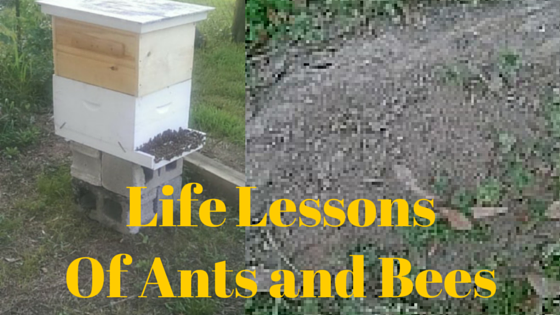
Life Lessons of Ants and Bees


Proverbs 6:6-8
6. Go to the ant, you lazy man! Observe its ways and become wise.
 7.  It has no commander, officer, or ruler,
 8.  but prepares its provisions in the summer and gathers its food in the harvest.

There are untold life lessons that are demonstrated around us daily. We could go our entire lives and never see them. In our modern world many of the lessons we should be learning are taught by creatures that in certain situations would be considered pests. Ants and bees are perfect examples.

If you have ever had the opportunity to watch ants or bees work you have to admit that they are amazing. The ant has been mentioned many times throughout history for it's industry or work ethic, no one who has ever watched ants work will deny that. What lessons can we see taught by these insects? We are going to go through a few. These are simply observations and human applications for these insects behavior.

All Ants and Bees Are Doers

There is no such thing as a lazy ant or bee. All of the members of the colony or hive are workers. Everyone has a job. There are workers, soldiers, and of course the queen. The queen isn't really a ruler though. For many species there are even different groups of workers. For ants there are foragers, gardeners, harvesters, nannies, and even more. The soldiers job is simple defense. Everyone works, everyone has a job, and everyone is important.

Be Courteous

While watching ants work you will notice that once a resource is found ants will go single file to that resource until it is exhausted. They will meet other ants coming back from the resource. Every time an ant meets another ant they stop very briefly. When they do this they are communicating. Ants lay down scent trails that communicate where resources and even where danger is, they even verify that they are members of the same colony.

The honeybee is similar but different. Scouts go out to find resources, when they come back they are greeted by the guards and workers. The guards verify that these scouts belong to this hive and the workers learn where the best pollen or nectar can be found. Communication is key to the survival of both of these insects. They are being courteous to each other because they are all on the same team and working toward a common goal, the survival of their colony. Always be courteous to other doers.

Don't Get Hung Up On One Way To Do Things

One thing about honeybees and ants as soon as something is used up they move on to something else. I know people who do everything the same way every day. There are some that are so programmed that they cannot deal with interruptions or changes of plan. I hate to say this, but there are some days that are just an adventure. It doesn't matter how much you plan, it will not work the way you want.

When I was in college, we had to read a book called Who Moved My Cheese? This is a fairly short book and really could have been shorter, but it does give an important message. Don't rely too much on the same way of doing things. I do suggest everyone read this little book, it will help you.

Prepare for the Future

Each and every member of the colony or hive is working on being prepared. They are gathering food, way more food than they need each day. They are building a deep pantry because tomorrow may storm and they will not be able to work outside. They are storing up as much as they can so their community will be able to make it through the hard times. 

Life Can Still Be Sweet

This lesson comes specifically from honeybees, but I think it applies. While you are working on providing not only your daily provision you are also laying up stores for the winter. When winter time comes you get to relax and enjoy the fruits of your labor. Nothing is better than fresh honey.

Stay True To Family

Both ants and honeybees are just one really big family. Everyone is helping everyone. Competing for things with other families but doing so for the most part peaceably. Every member is important.

Thrive Where Ever You Are

One thing I have always respected about almost all insects, especially honeybees and ants. They make the best of where ever they are. Think about it. Honeybees will make a home in a hive that we provide, a hollowed out tree, the cleft of a rock, and even if you are far enough south just a covered branch of a tree. They improvise and make the best of what is available. The same can be said of ants. I am sure you have seen an ant bed that the entry point was in the crack of a slab of concrete. I am not saying that you shouldn't strive to achieve better. What I am saying is that you should be a good steward of where you are.

Defend Your Home With Zeal

What to know what pain is? Mess with a beehive or an ant mound. Every member of the family will rise to defend their home. Honeybees give their very lives in defense of their family. I will never understand why we, as supposed superior beings have such a hard time defending our families. I am not just talking about defending our families when they are in physical danger. I am talking about a whole lot more.

I am sure you know at least one person, probably several, that talk bad about their spouse out in public. There are people who are not a good husband or wife that is true, but some of these people berate their spouse even though they love them dearly. I believe that when you have chosen a spouse you are no longer two people, you have become one. Our job is to be encouraging and supportive as much as possible. When we need to give our spouse a reality check we should do it in private. This builds respect and respect is something we all need. 


Have something to add to this topic join the Forum on The Rural Economist. If you would like to contribute to the conversation we would love to have you join us. It is brand new, but I am sure it will grow. 


Subscribe to our mailing list

* indicates required


You can like The Rural Economist on Facebook follow on The Rural Economist on Gplus. We now have a YouTube channel and we cover all sorts of things. Hop on over and check them out, oh and don't forget to subscribe. I have just joined Instagram if you would like you can follow us HERE. We will be sharing several things over the next year, I hope to see you there. 

Check out The Rural Economist on Pinterest


Affiliate Link Disclosure: This post may contain affiliate links. I may receive compensation for links, endorsements, testimonials, or recommendations for any products mentioned on this blog. Any time you use one of our links for Amazon, if you purchase something The Rural Economist receives a small commission and it doesn't cost you any more. Even if you do not purchase the items I list. In this way you will help support us trying to teach people about self reliance and homesteading. Thanks for your consideration.